CASE STUDY
Nexus Persona Ecosystem
Building the Foundation for a Human-Centered Enterprise Capability
Domain: Enterprise Service Design (B2E)
Timeline: 6-month Build Phase; Alpha ongoing
Role: Senior Experience Designer, Strategy, Research & Activation Lead
Process Phase: Reveal
NEXUS PERSONA ECOSYSTEM
Table of Contents
Project background, core challenges to solve, and my role.
Definition of the project goal, key guiding questions, and success criteria.
High-level introduction to the proposed solution and overall strategic direction.
Summary of research methods, insights gathered, and key findings that informed design direction.
Overview of early design exploration including foundational information architecture, co-creation and concept sketching.
Description of the prototyping process, testing approach, feedback loops and refinements.
Showcase of final solution.
Explanation of implementation strategy, alpha testing, and stakeholder engagement.
Presentation of outcomes, impact and key learnings.
Links to related work case studies.
SITUATION
When research lives on a shelf, assumptions drive decision making creating fragmented experiences.
A large retail organization was spending thousands on personas, but they weren’t being leveraged. Teams repeatedly requested them, leadership continued to fund them, yet decisions continued to rely on assumptions, not validated research. Fragmented experiences compounded, driving projected inefficiencies of over $50M/year.
The gap wasn’t personas; it was a lack of meaningful activation and integration as a decision-making tool.
Challenges
Personas were often created but rarely used.
Strategic decisions were often based on assumptions, not research, leading to misguided solutions and broken experiences.
Multiple brands, fragmented teams, and silos created a highly complex environment that was largely undefined and misunderstood.
Constraints
Legal and corporate communications had to approve all research plans and materials.
Holiday blackout periods and union rules limited access to store employees.
An unexpected IT security incident reduced team capacity, budget, and time.
Some internal stakeholders were hesitant to participate in the project.
My Role
I led end-to-end research, strategy, and activation while partnering with UX designers on the repository experience. I set the strategic direction and evolved Nexus from a persona repository toward a scalable enterprise insight and Service Design capability.
Team: Partnered with four in-house UX designers and a three-person consultancy team (two visual designers, a project manager, and a change management specialist).
“How might we create scalable access to personas to equip teams across the organization with practical, actionable user understanding to make more human-centered decisions?”
TASK
Design for active adoption, not static documentation.
Goal
Shift personas from static design artifacts to dynamic decision-making tools used across teams to influence strategy, design, product development, and delivery.
Key Questions
How can we make personas credible, usable, and actionable?
How can we visualize complex organizational relationships clearly?
What barriers currently block persona adoption and how can we mitigate them?
Success Criteria
Teams use personas independently for decision making.
Persona content is usable, relevant, and actionable.
Barriers to adoption are identified and addressed.
Interdependent organizational relationships defined and communicated visually.
SOLUTION PREVIEW
Nexus powers human-centered, outcome-driven ways of work.
We launched the initial ecosystem with 24 research-based personas, later expanding it to 30+ validated profiles as the capability evolved.
Impact: The ecosystem makes user research easily accessible to non-design teams, helping support more data-informed decision making. We also streamlined the persona creation process, saving hundreds of hours and more than $600K annually in design labor. Beyond operational efficiency, this work ignited a strategic shift toward experience management, laying the foundation for an enterprise service design capability.
-
The Persona Library acts as a central hub that helps users explore persona profiles relevant to their work.
-
Robust persona profiles provide rich insights and data points, from in-depth needs and pain points to tools, communication channels and common collaborators.
-
The ecosystem map showcases connections between departments and groups across the organization, bringing clarity while navigating complex organizational layers.
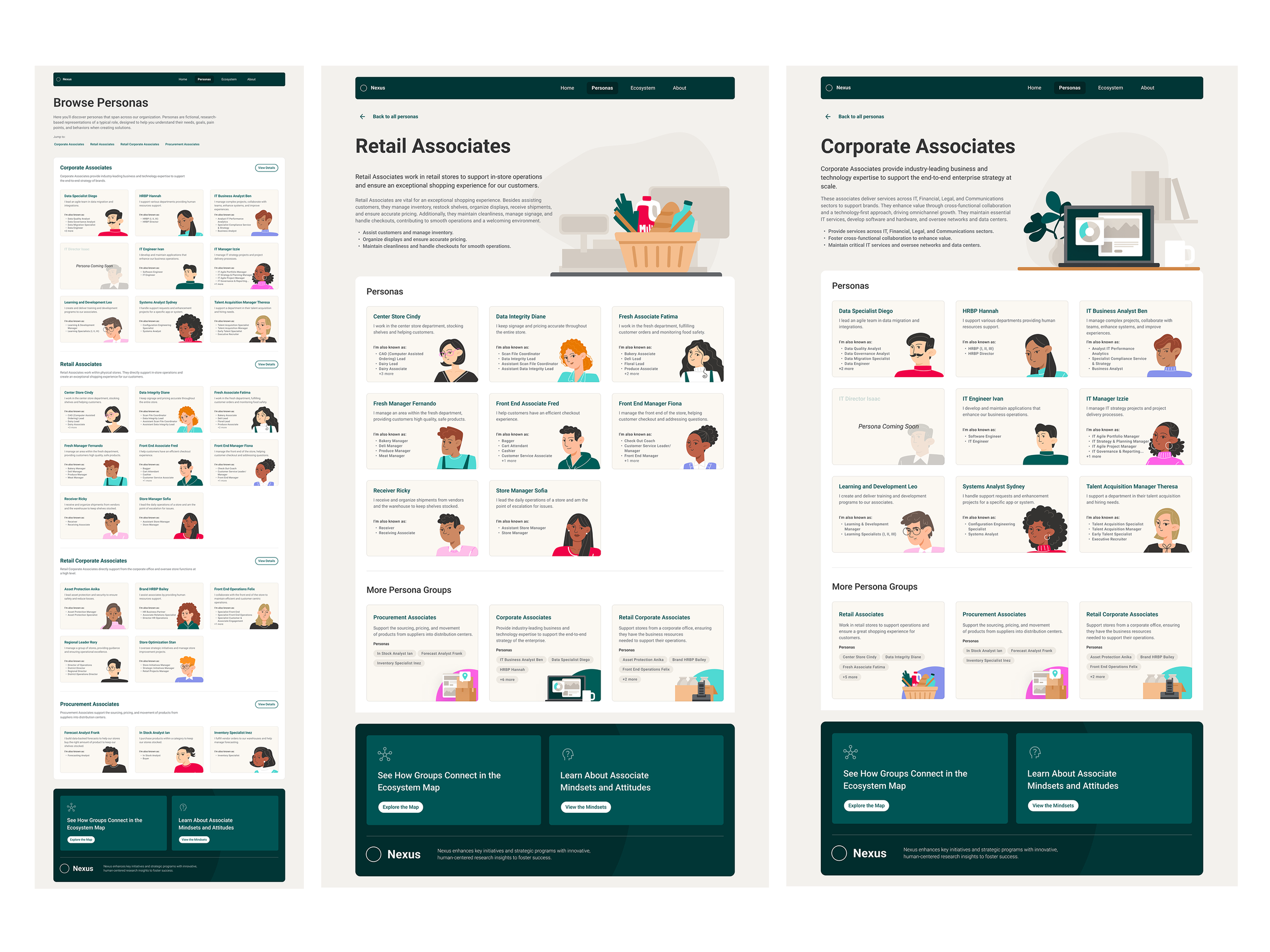
Persona Library
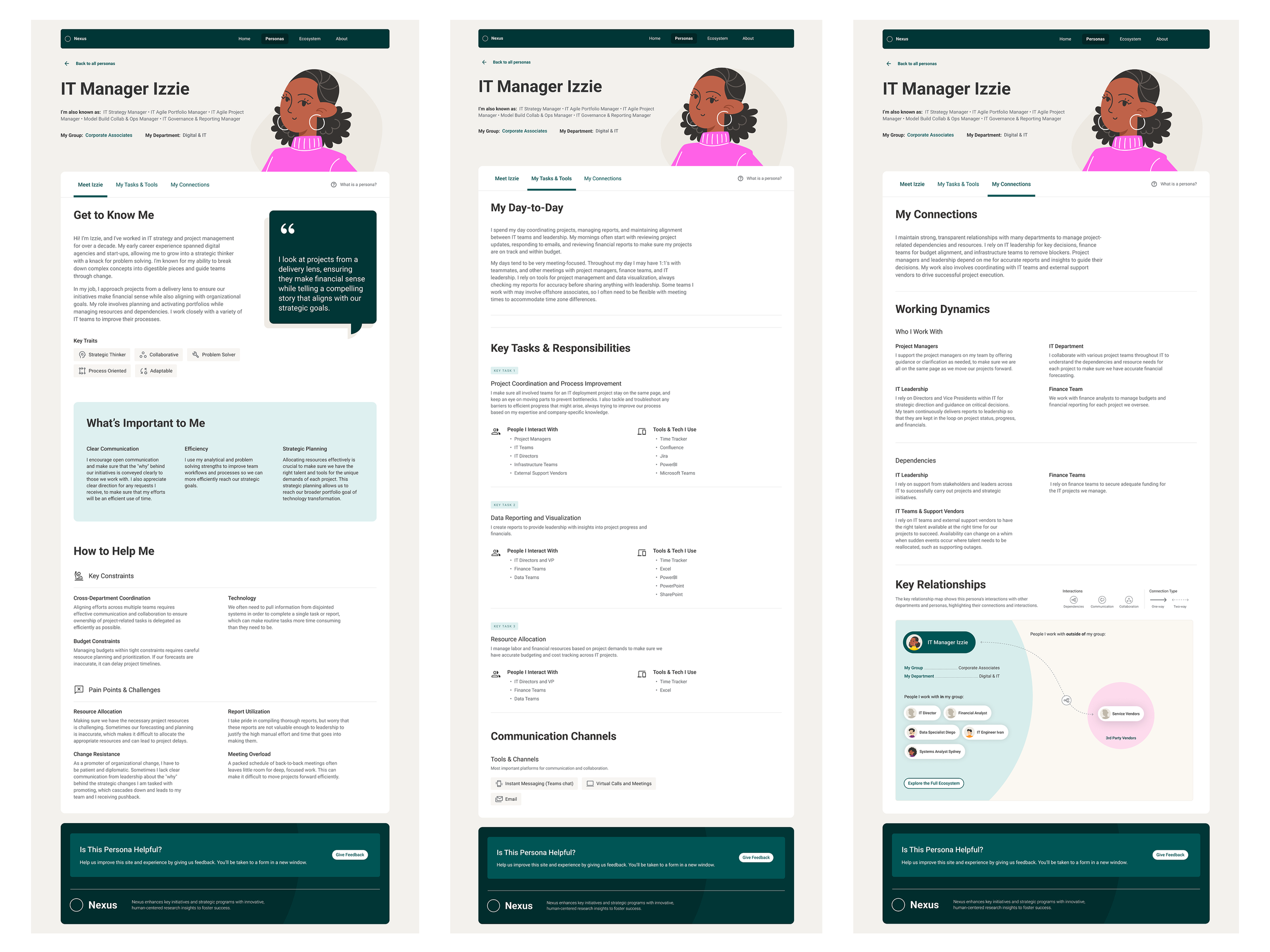
Persona Profile
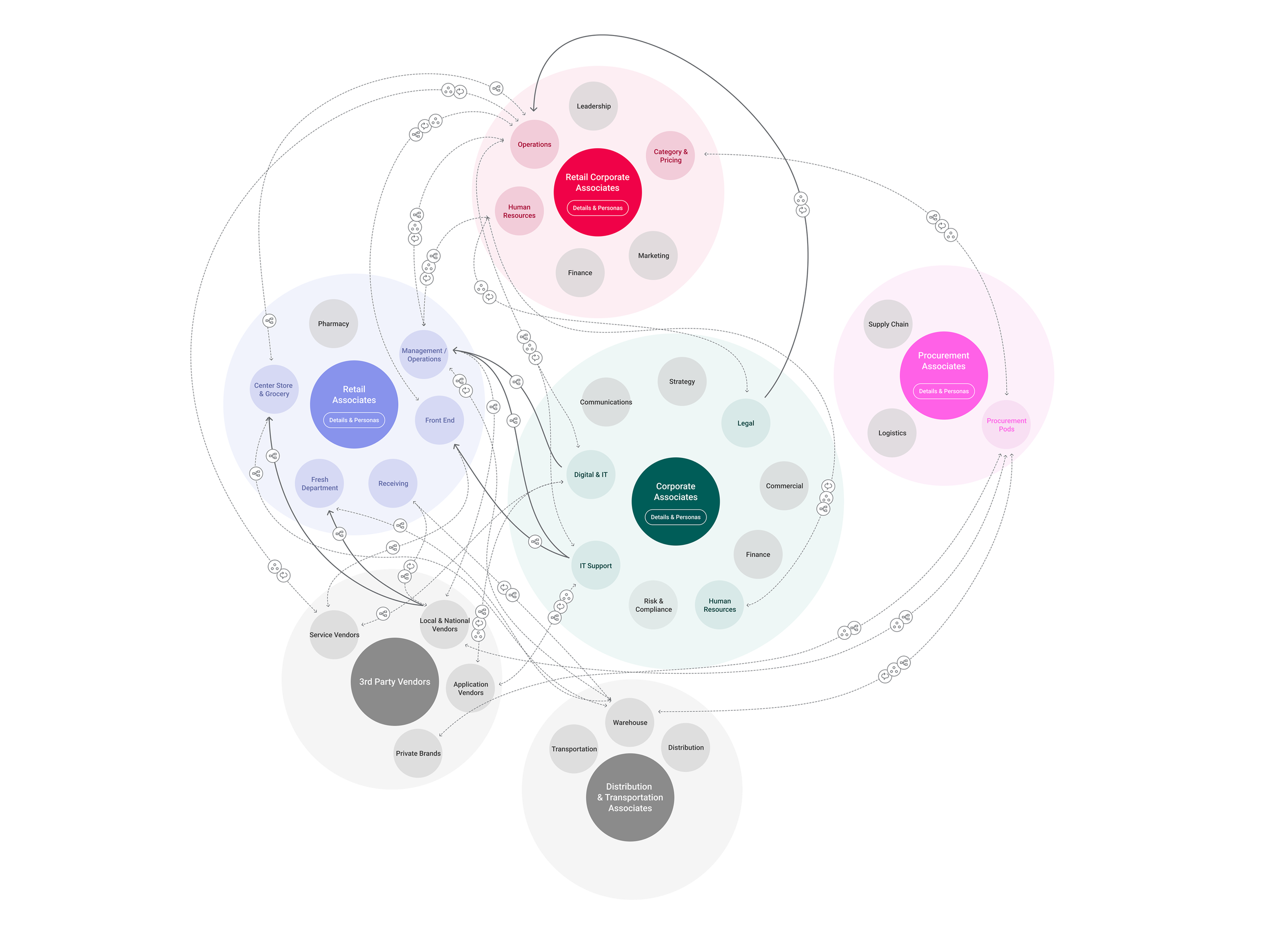
Ecosystem Map
RESEARCH & DISCOVERY
100+ interviews exposed critical gaps and complexities that role titles and org charts didn’t reveal.
Operating under tight legal, security, and timeline constraints, I co-led a rapid research initiative to build a reliable foundation for persona development across multiple brands.
Co-facilitated a prioritization workshop with stakeholders aligning on the highest-impact roles to research.
Conducted 100+ cross-brand interviews to inform persona development.
Designed a large-scale cross-brand survey to expand validation with quantitive evidence (*later postponed due to timeline changes and permission restrictions).
Standardized research scripts, note-taking, and synthesis workflows, using AI-assisted analysis to accelerate insights without sacrificing rigor.
Mapped cross-role dependencies to understand how teams connect and interact within the broader enterprise ecosystem.
Key Insights
Job titles were often inconsistent with actual responsibilities, requiring the team to redefine and reprioritize personas based on real workflows.
Cross-role dependencies were far more complex than expected, revealing an interconnected ecosystem rather than isolated roles and teams.
Standardizing the research process and integrating AI in the workflow enabled faster synthesis under compressed timelines, but human oversight was essential to maintain quality and consistency.
Strategic Decisions & Trade-offs
An unexpected security incident reduced the research timeline by eight weeks. I worked with leaders and stakeholders to realign priorities to achieve the highest value outcomes.
Narrowed the scope from 30 to 24 personas to maintain research quality while meeting delivery deadlines.
Postponed the cross-brand survey to prioritize qualitative insights and accelerate persona development.
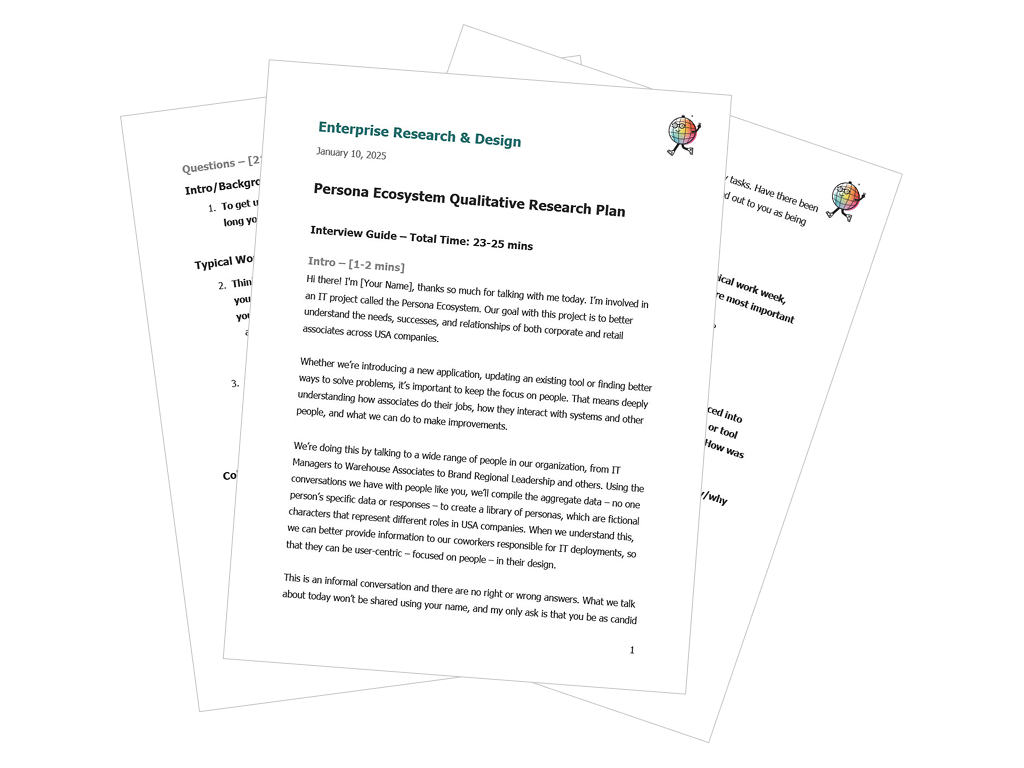
Research Plan
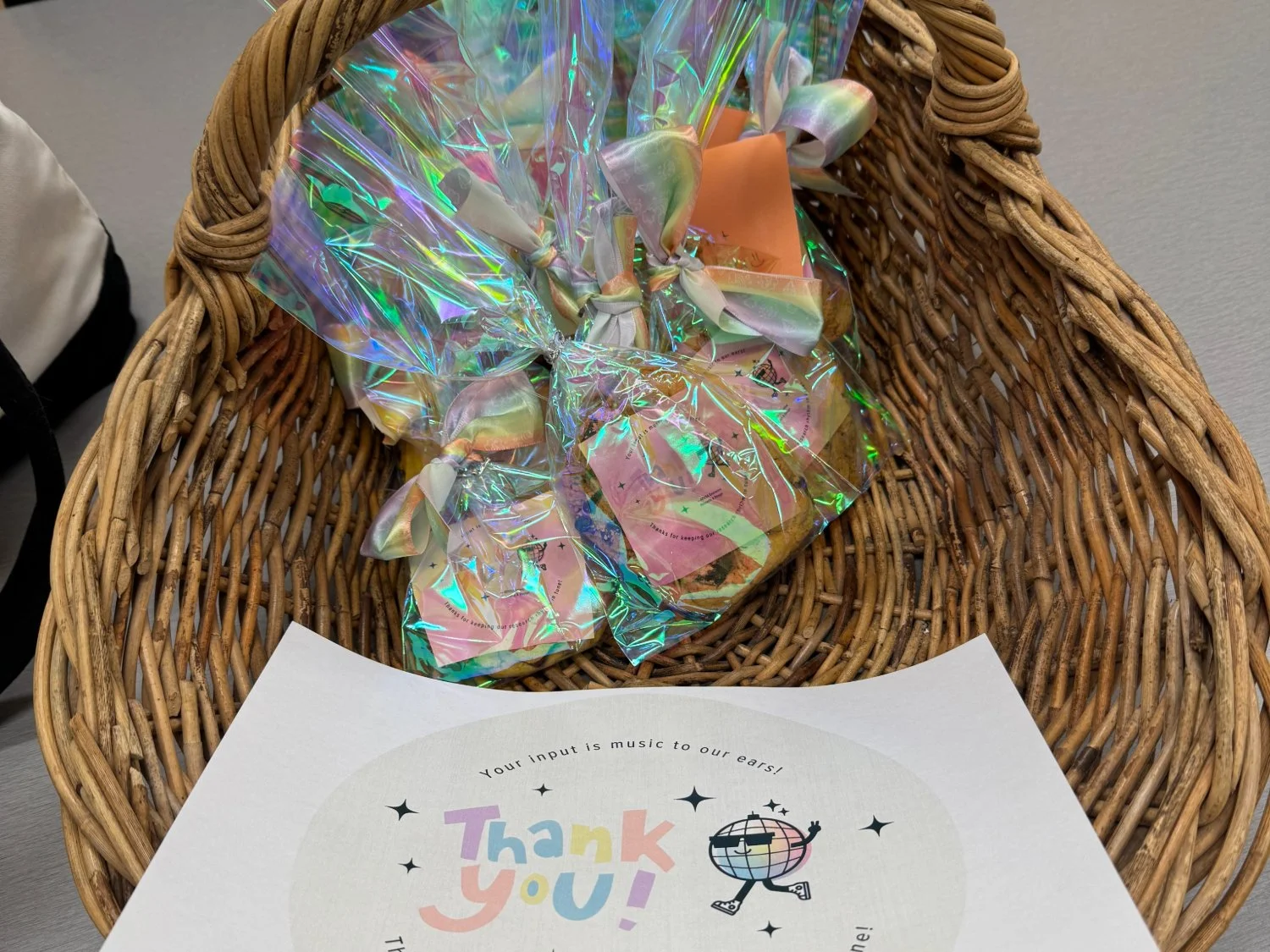
Showing our appreciation!
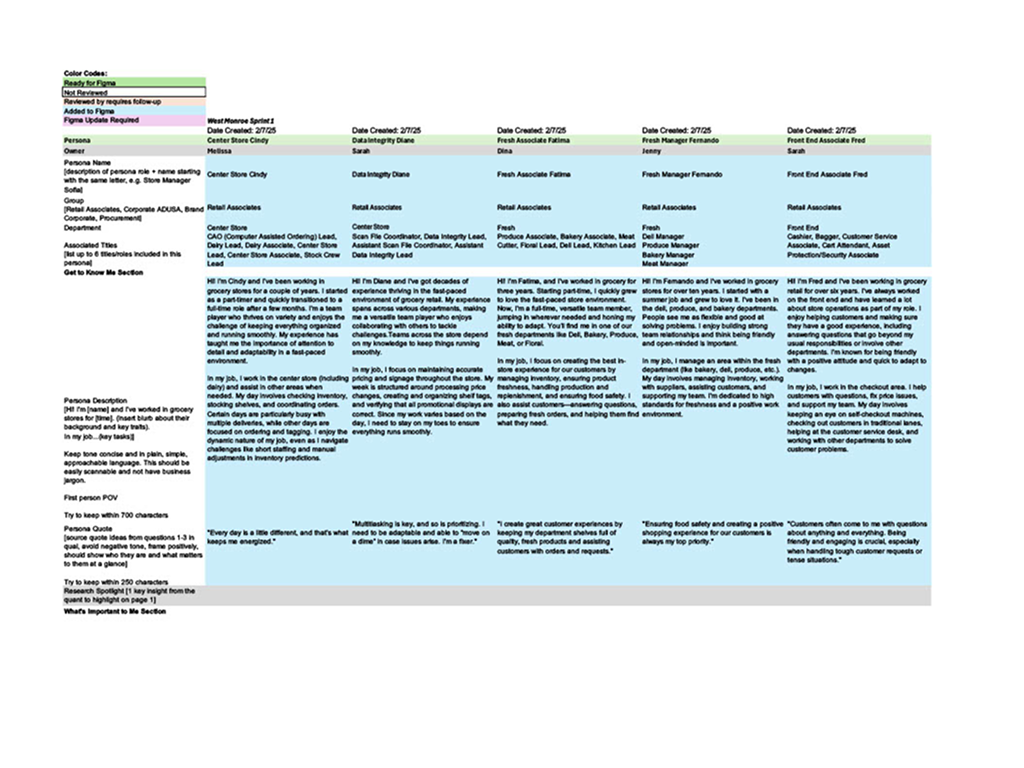
Synthesis Spreadsheet
DESIGN & CO-CREATION
Co-design fueled creativity, but gaps in foundational information architecture led to breaks in the UX.
Using research insights as the foundation, I led a collaborative design process to define the structure, content, and usability of the persona repository. A co-design approach ensured stakeholders remained engaged and aligned throughout development.
Facilitated cross-functional workshops to define the persona framework and prioritize high-value content for teams.
Used card sorting exercises to establish a high-level navigation structure.
Rapidly explored concepts through sketching and low-fidelity wireframes to validate ideas early.
Key Insights
The complexity of roles and responsibilities made defining persona content and layout more challenging than expected, establishing the need for more in-depth end user testing.
Early collaborative workshops and paper-based sketching accelerated alignment and built stakeholder confidence in the overall design direction.
Strategic Decisions & Trade-offs
To meet aggressive timelines, some foundational UX steps were compressed, creating important lessons for future work.
Skipping deeper information architecture exploration introduced downstream UX challenges during later design stages requiring costly, time consuming, and frustrating re-work.
Earlier usability testing at a low fidelity could have surfaced structural gaps sooner, reducing heavy rework during high-fidelity design and prototyping.
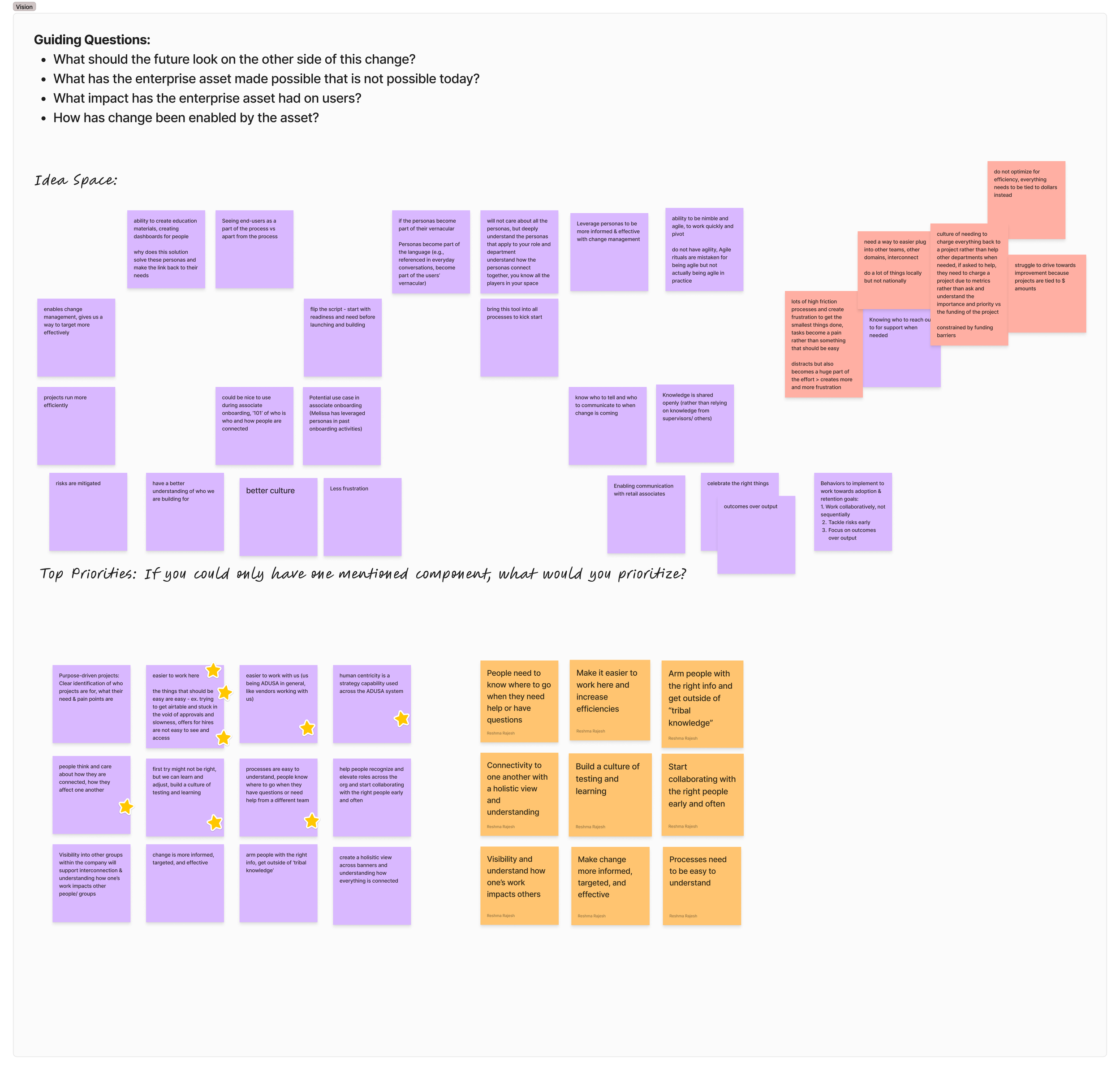
Visioning Workshop (FigJam)
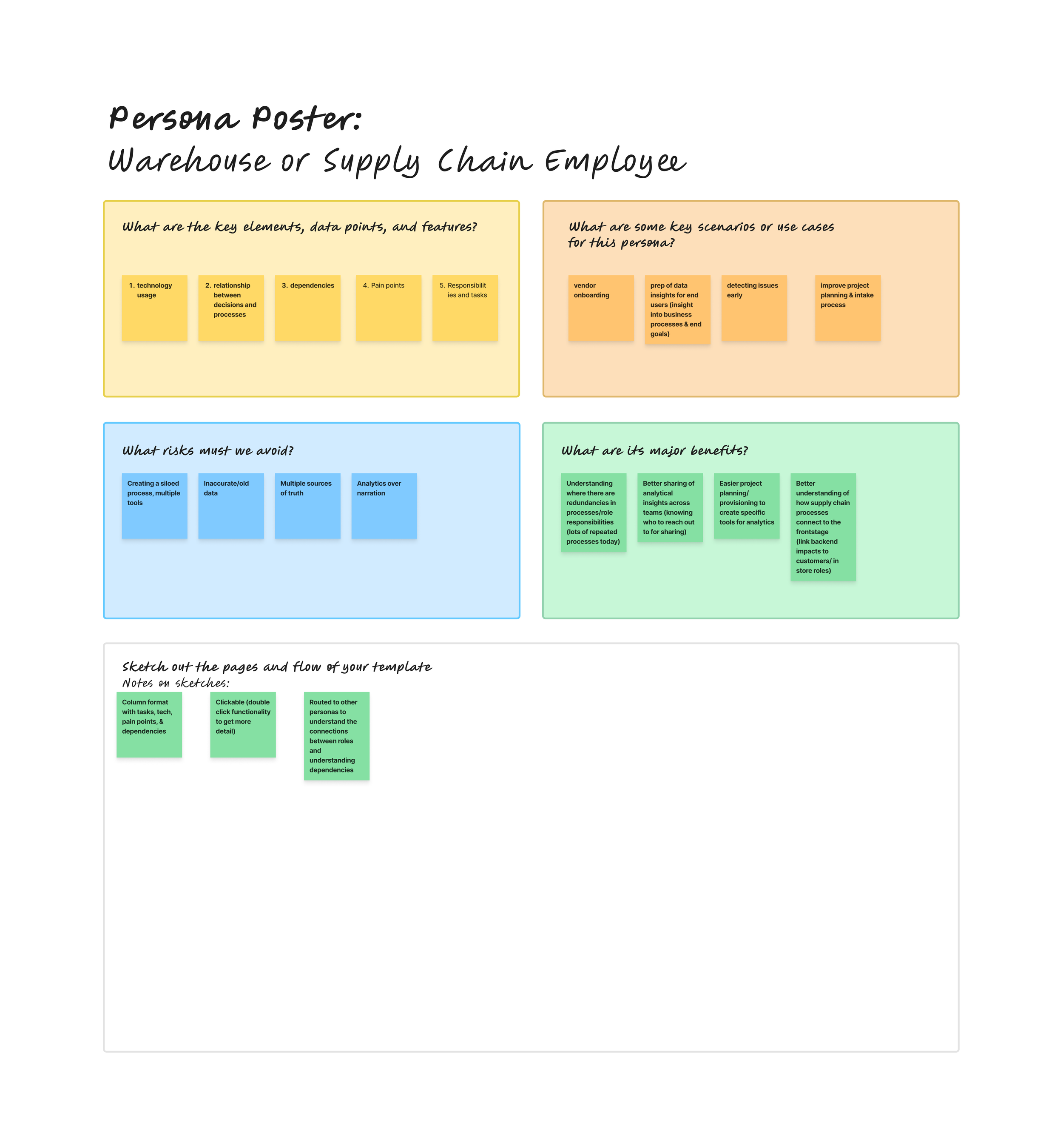
Persona Content Prioritization (FigJam)
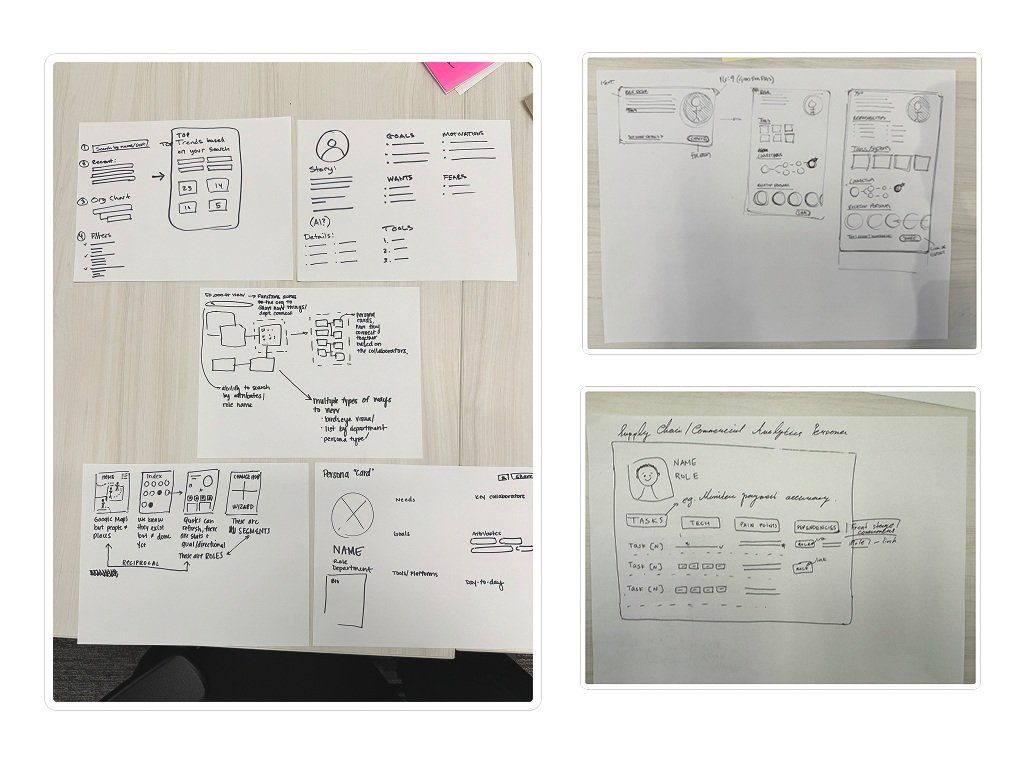
Co-Creation Sketches
PROTOTYPE & TEST
Users navigated easily, but couldn’t apply persona insights signaling a critical knowledge gap.
We created a high-fidelity prototype and led iterative testing with key stakeholders to validate usability, clarity, and practical application.
Developed a high-fidelity prototype.
Conducted usability testing with 10 cross-functional co-creators, iterating on content, layout, and repository structure.
Key Insights
Visual polish alone could not compensate for gaps in the foundational information architecture requiring rework.
While users found personas easy to understand, they struggled to apply them in real workflows, highlighting the need for a stronger focus on activation and enablement.
The ecosystem map caused more confusion than clarity for users.
Strategic Shifts & Trade-offs
Recognizing sunk-cost bias, we made the decision to stop investing in the ecosystem map and redirect efforts toward improving persona clarity and adoption.
Shifted focus to strengthening persona usability and activation during the upcoming alpha testing phase.
Prioritized elements that would drive adoption and practical use across teams.
Introduced an “About” page to clarify the purpose of personas and how they can be applied in workflows.
-
Building shared customer and employee understanding.
Nexus creates a common foundation of validated insight that teams can use to better understand the people affected by their decisions.
-
Designed for activation, not documentation.
Training, workflow integration, and maturity measurement create the infrastructure needed to embed persona use as the capability scales.
-
Measuring readiness and preparing to scale.
A persona maturity model and quantitative assessment establish a baseline for team understanding and help target future activation support.
ACTIVATION (ALPHA)
Modeling use, not just building tools, inspired adoption & accelerated persona impact.
Testing revealed the core challenge wasn’t usability, but adoption. Teams understood the personas, but not how to apply them in their work. We reframed the Alpha phase to focus on behavior change and workflow integration, not solely tool usability.
Deployed Nexus with an active product team.
Designed a Persona Proficiency Model to measure understanding and practical application.
Created and deployed a “Persona Quest” assessment to track team confidence and adoption within existing workflows over time.
Developed and facilitated a targeted team persona training.
Embedded persona use into multiple product sprints, guiding teams on practical application.
Key Insights
Training helped establish a baseline understanding, but did not drive adoption on its own.
Adoption increased significantly when designers modeled persona use during real product work, making the value tangible for teams.
Product owners and scrum masters proved to be the strongest adoption drivers, especially when applying personas in planning and prioritization.
Teams desire more contextual tools alongside personas; journey maps emerged as a stronger complement than ecosystem maps.
The Persona Proficiency Model created a measurable baseline for adoption that can scale across additional teams.
Strategic Decisions & Trade-offs
Insights from alpha testing informed several strategic pivots accelerating adoption and long-term impact.
Shifted the initial activation strategy from targeting all associates to a designers-first approach, creating controlled leverage for broader human-centered change across teams.
Expanding Nexus to include journey maps alongside personas, pivoting from ecosystem mapping toward journey management.
Positioned Nexus as the foundational platform for an enterprise-scale service design capability.
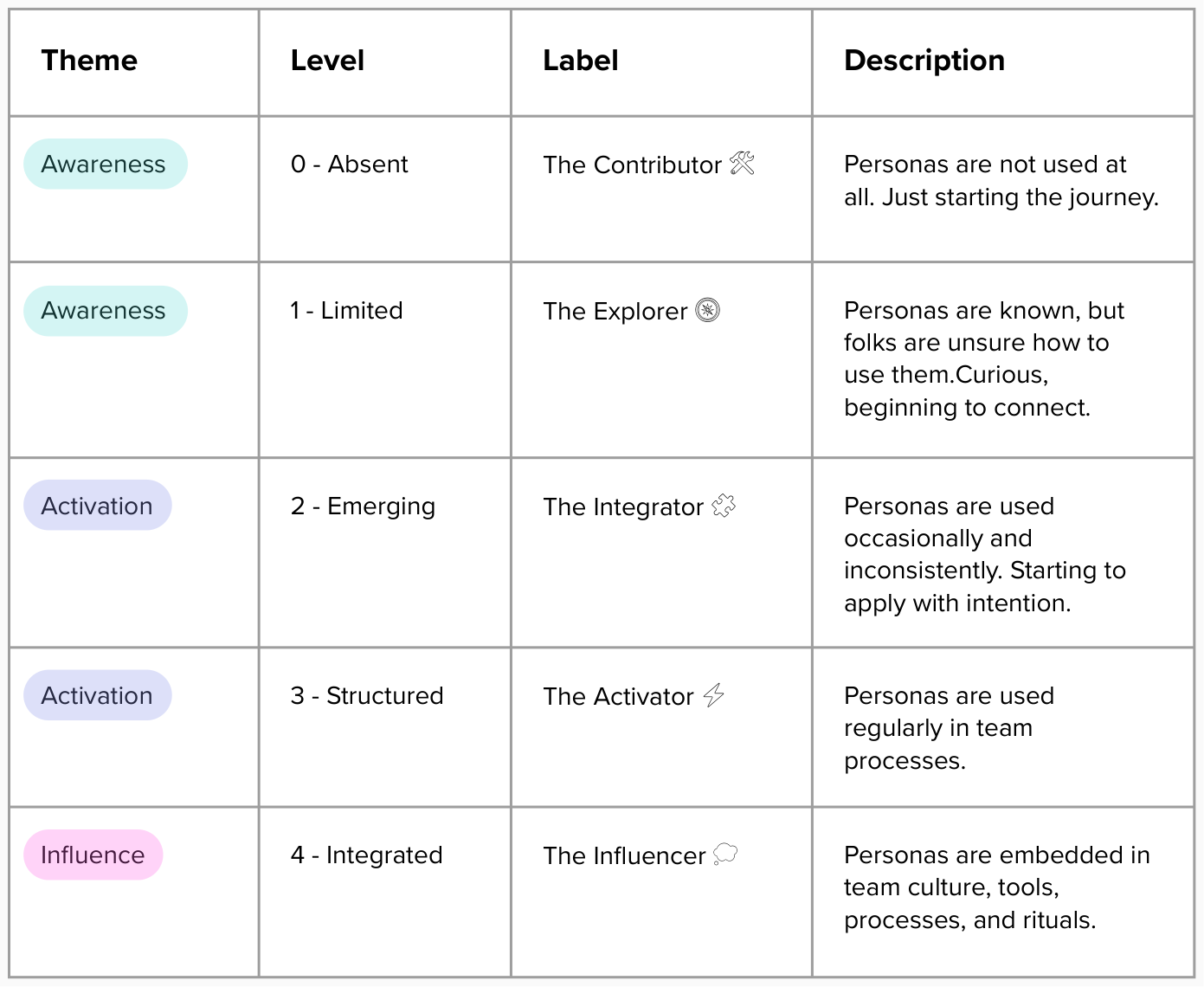
Persona Maturity Model Levels
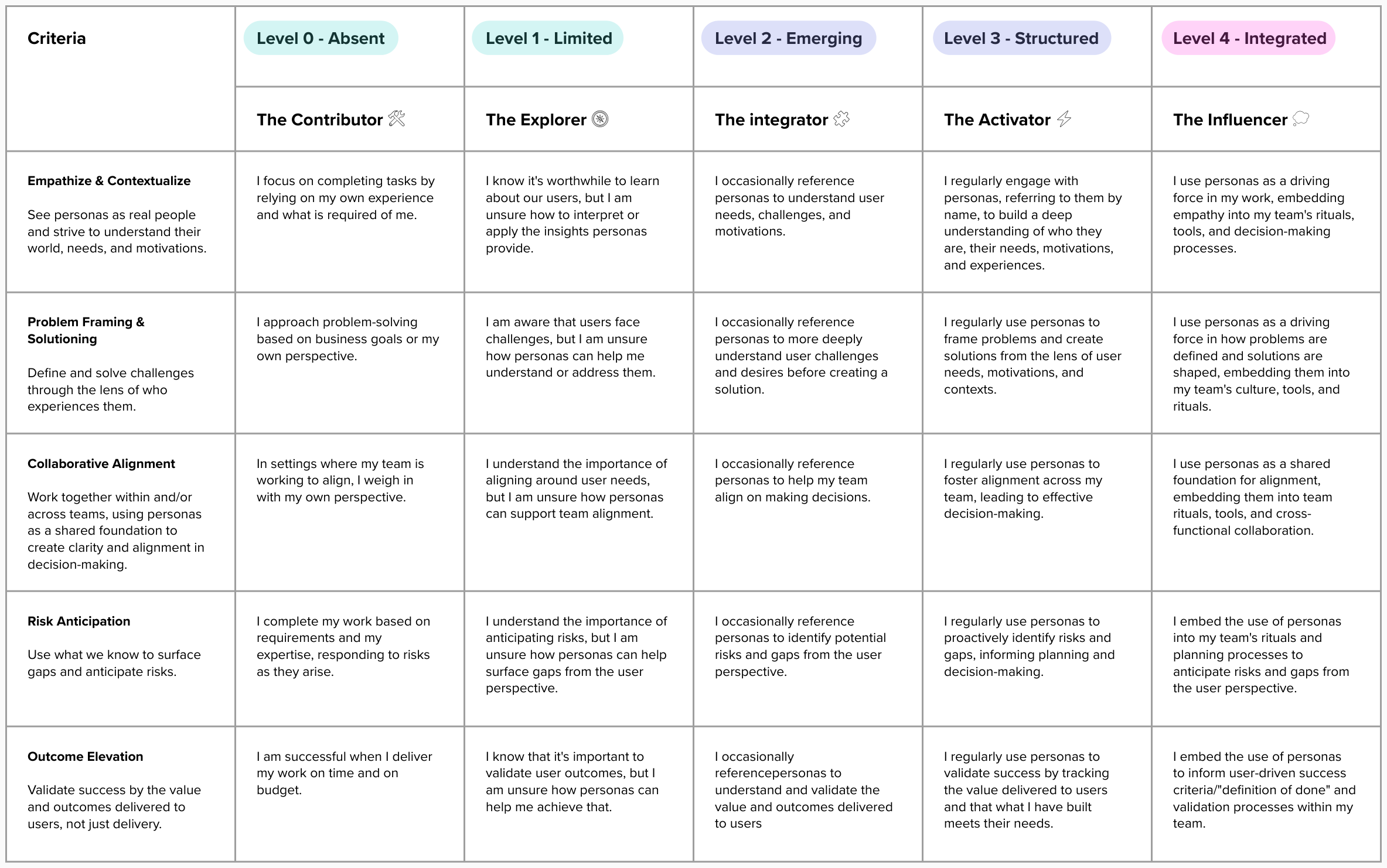
Persona Maturity Level Details
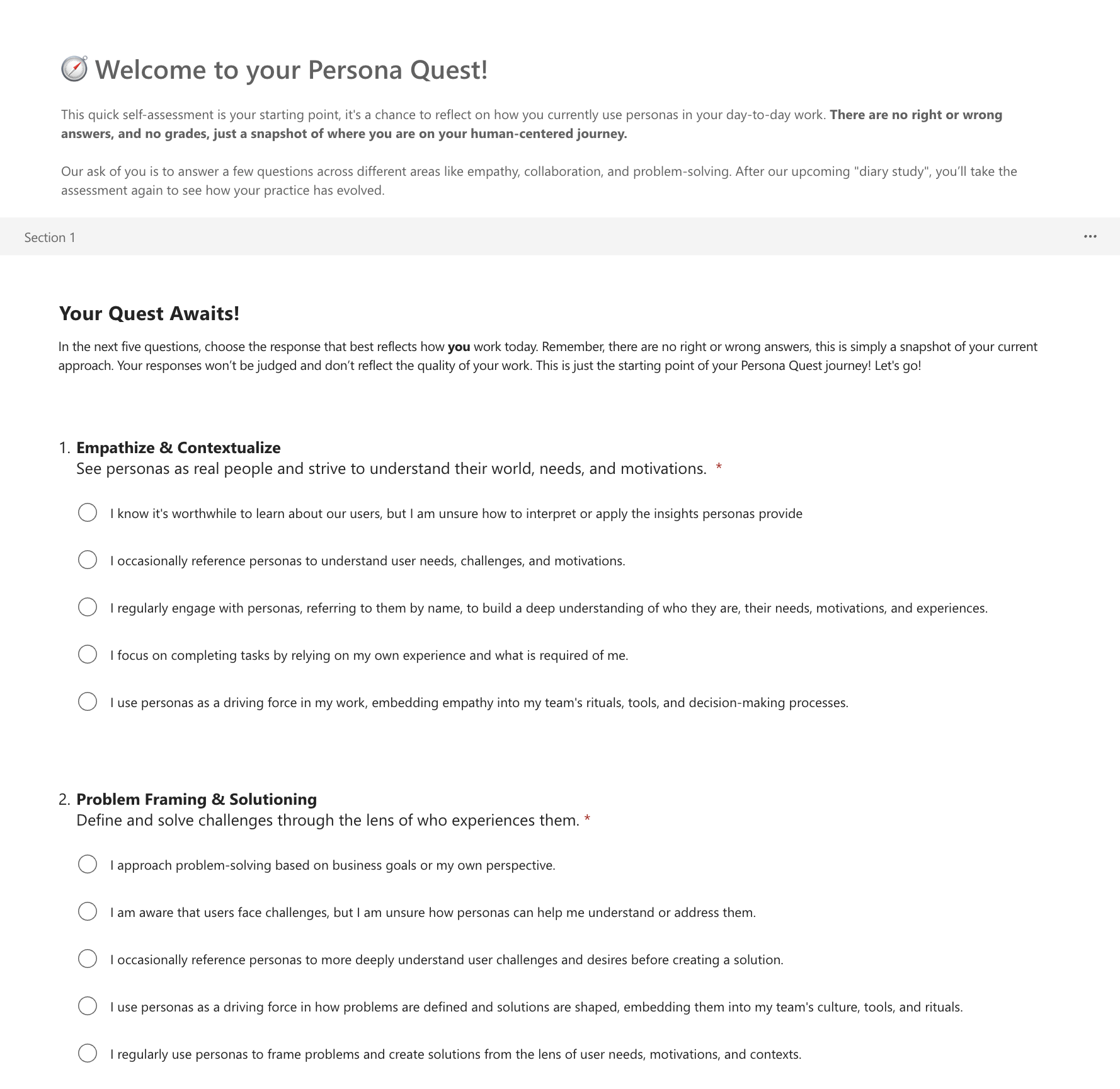
Persona Quest Survey
Despite adoption challenges, we’re learning and moving forward, turning lessons into progress and forging a brighter future through human-centered design.
RESULTS & IMPACT
Nexus tested me - and taught important lessons about influencing human-centered practices at scale.
Nexus didn’t go exactly as planned, but that’s OK. The work still generated critical insights that reshaped our approach to human-centered design.
Testing validated that personas could effectively influence research based decision making, but it also surfaced a key limitation: teams need designer-led guidance and deeper journey-level context to apply them meaningfully. This insight prompted a strategic pivot from ecosystem mapping to journey management, repositioning Nexus as the foundation for building an enterprise-scale service design capability.
Impact
The ecosystem is continuously growing, now with 30 validated personas available for use.
The work informed a standardized persona creation toolkit with AI assisted synthesis, reducing redundant research and saving an estimated $600K annually in design labor.
Demonstrated and measured an early shift from solution-first thinking to more human-centered decision making.
Partnered with design leaders to redesign our intake and project workflow, embedding personas across the full lifecycle, from early discovery and pre-service planning through active design and post-engagement activation.
Nexus is evolving from a persona ecosystem into a journey management platform supporting broader service design capability development such as journey mapping.
Personas from Nexus now inform strategic initiatives across the organization, including Retail Item Management.
Key Lessons
Focusing research more deeply on end-user needs, rather than personas alone, would have surfaced critical gaps sooner saving time, money and frustration.
Skipping foundational information architecture to save time introduced significant downstream complexity and rework.
Knowing when to stop investing in a concept is as important as knowing what to build.
Flexibility and adaptability are essential when navigating complex, ambiguous enterprise environments.
Evidence-based insights build the credibility needed to drive adoption and organizational change.
Next Steps
Nexus is evolving into a journey management sandbox, enabling teams to experiment with interconnected journey frameworks, journey maps, personas, and service blueprints before committing to third-party platforms. This work is laying the groundwork for enterprise-wide service design adoption and transformation.
Continue the journey by reading these related case studies.
-
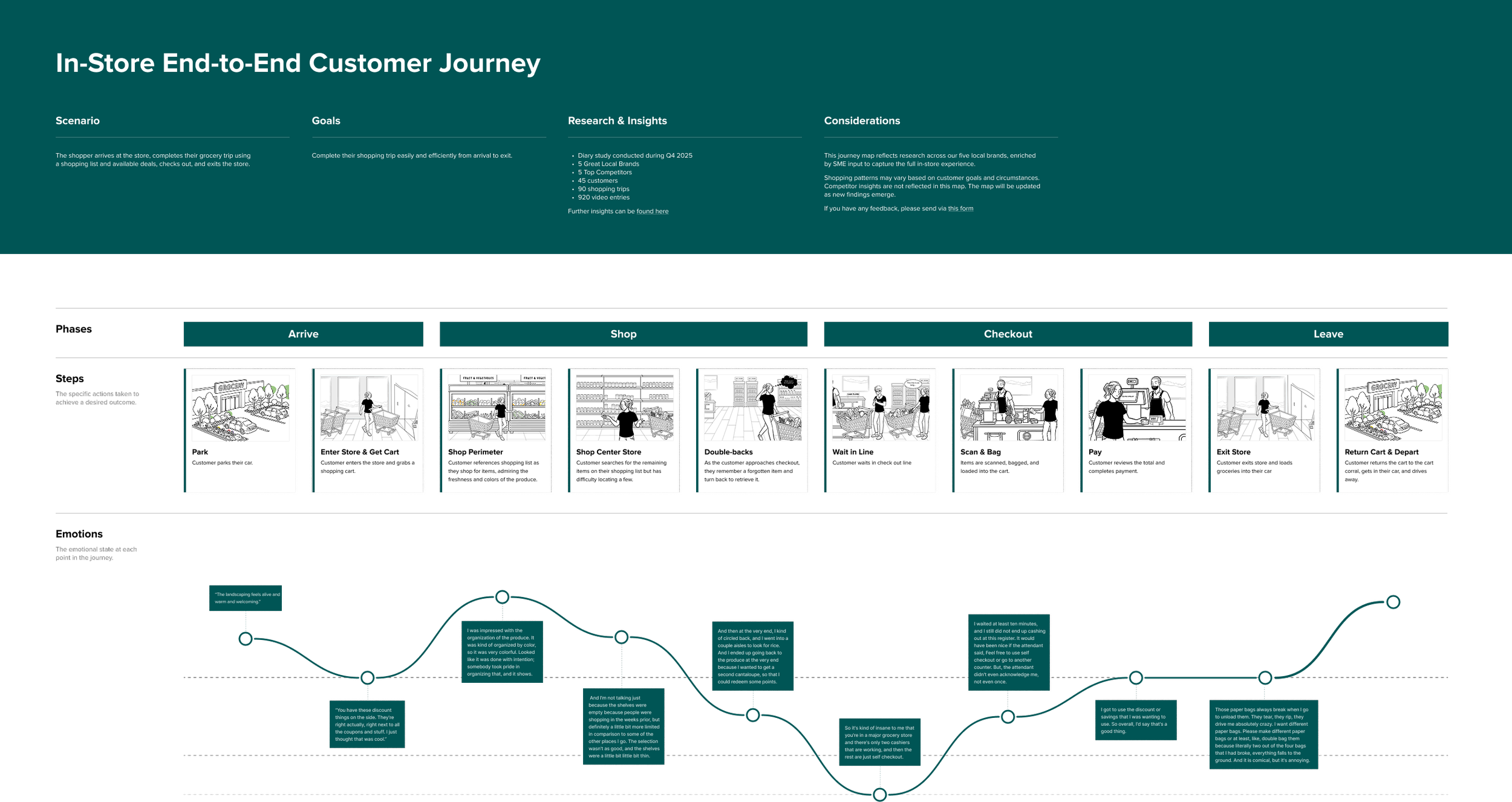
Translate: Enterprise Journey Management
Create a shared view of the end-to-end experience.
I established and lead the organization’s foundational Journey Management capability, connecting customer journeys, associate service blueprints, and scalable governance to uncover systemic gaps and inform experience strategy.
-
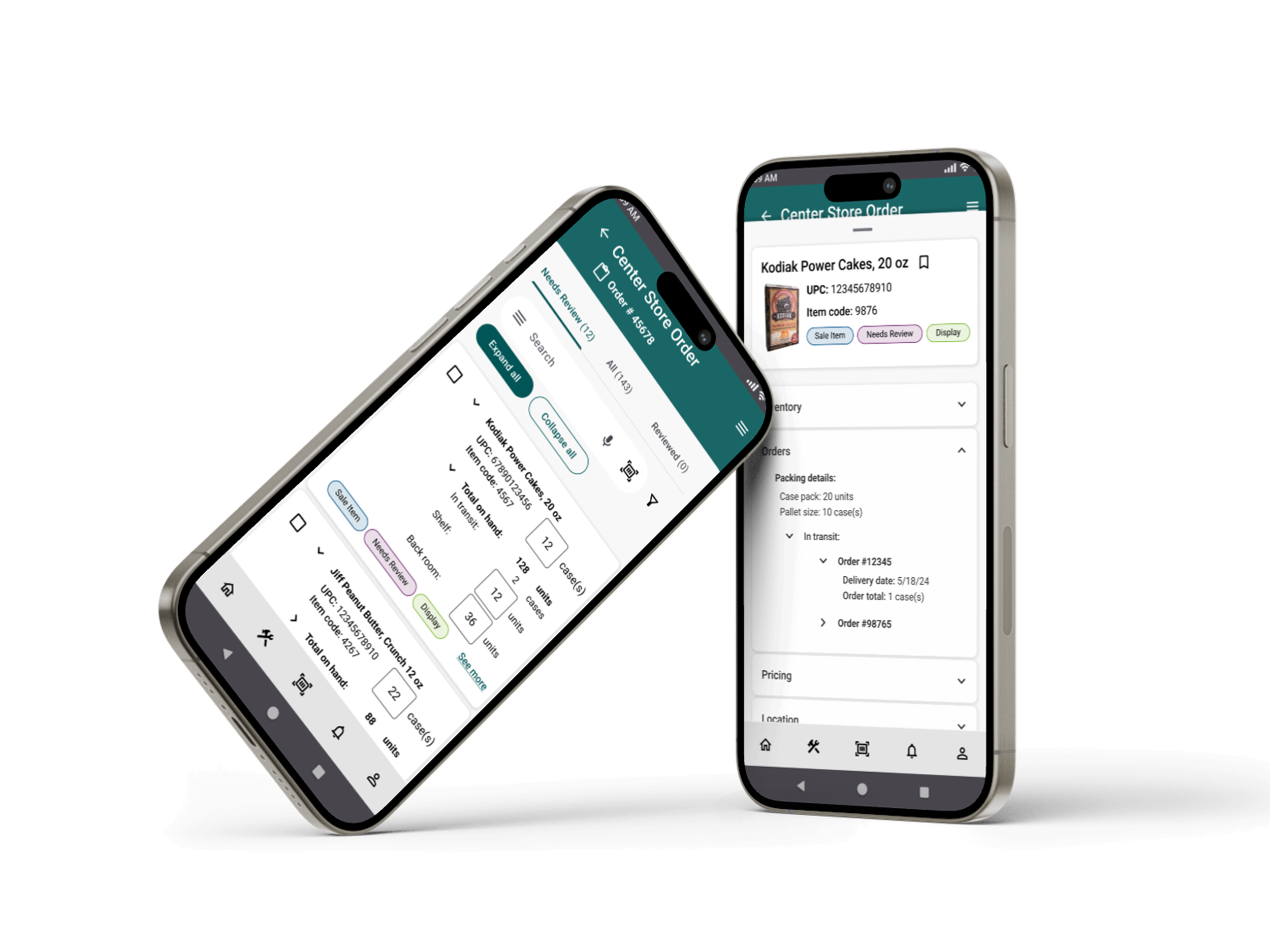
Transform: Legacy System Modernization
Design across people, processes, and technology.
I led a major enterprise modernization initiative consolidating multiple legacy systems and 40+ fragmented workflows into a single future-state concept, aligning leadership on a multi-million-dollar investment strategy.
-
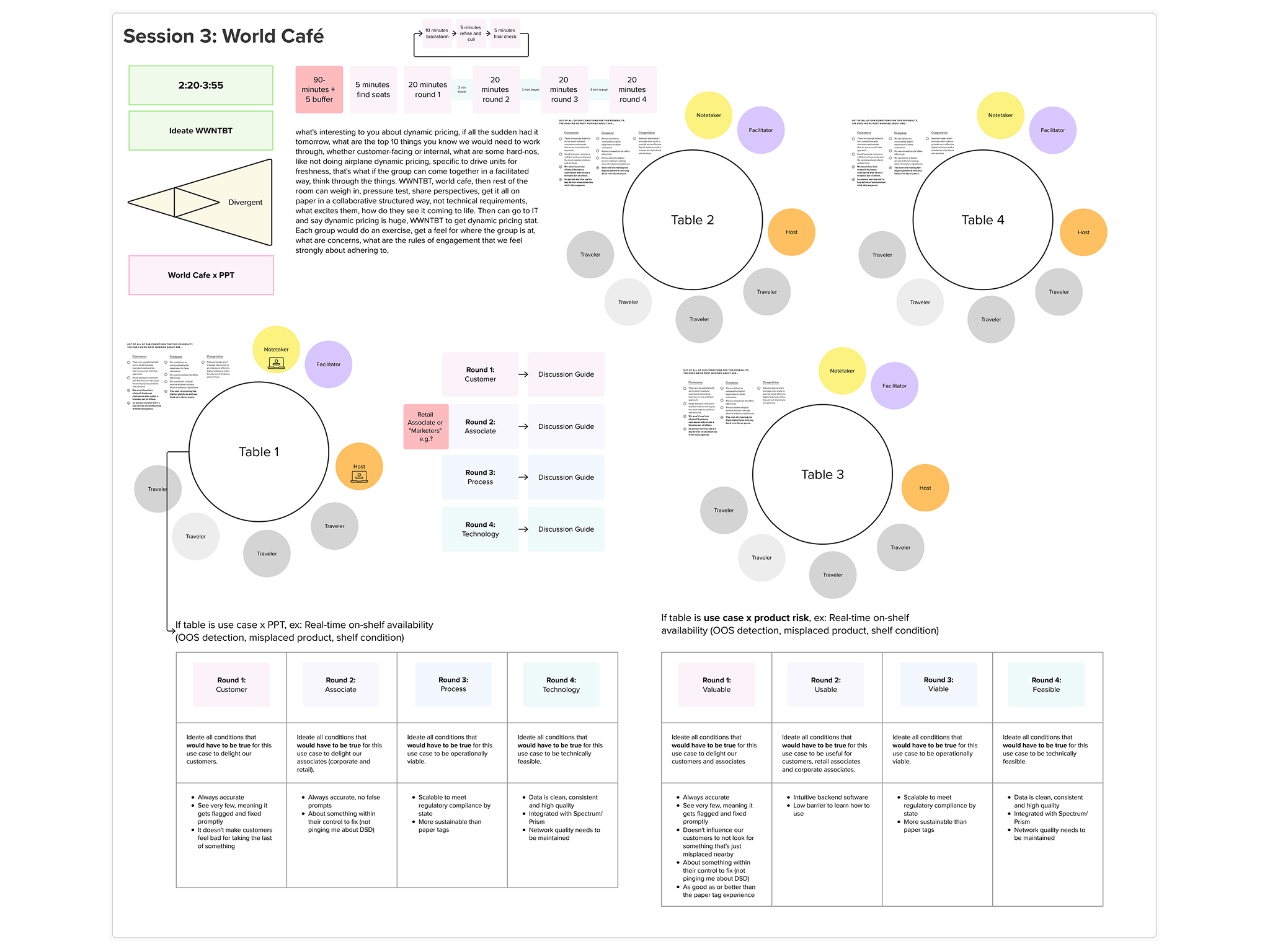
Enable: Executive Visioning & Alignment
Turn complexity into shared direction.
I designed and facilitated a high-stakes executive alignment workshop across brands and business functions, breaking more than a decade of stalled progress to align leaders on a shared Electronic Shelf Label pilot direction.