CASE STUDY
Modernizing Retail Item Management
Transforming Multiple Legacy Systems into a Single Source of Truth
Domain: Enterprise Service Modernization (Employee Experience)
Timeline: 4 months
Role: Senior Experience Designer, Research, Service Modernization & Future-State Design Lead
Process Phase: Transform
ITEM MANAGEMENT
Table of Contents
Overview of project background, the core challenges to solve, and my role.
Definition of the project goal, key guiding questions, and success criteria.
High-level introduction to the proposed solution and overall strategic direction.
Summary of research methods, insights gathered, and key findings that informed design direction.
Overview of design exploration, prototyping process, testing approach, feedback loops, and refinements.
Overview of outcomes, impact and key learnings.
Presentation of final prototype.
Links to related work case studies.
SITUATION
High-risk systems threatened operational stability costing millions in losses.
The systems were failing, leaving a multi-brand retailer on the brink of disaster. Hundreds of stores relied on unstable legacy inventory systems that frequently malfunctioned, costing millions and leaving newer associates without guidance as veteran knowledge retired. The organization needed a modern approach to Item Management to align brands, empower associates, and reduce operational risk. Leadership demanded speed, stores demanded stability, and unions limited access to end users, putting design credibility on the line.
Challenges
A misstep could delay modernization efforts for years leading to high operational risk.
Many in-store tasks required multiple systems, each with different processes across five different brands.
Manual processes were costing the company millions each year.
Long-tenured associates were highly skeptical of new technology.
Constraints
Short timeline and limited budget.
Corporate politics led to a historical gridlock on a common path forward.
Union restrictions limited access to retail end users.
My Role
I led research, Service Design, and future-state strategy across five retail brands, framing systemic problems, prioritizing critical workflows, and guiding co-design and prototyping with frontline associates and cross-functional partners.
Team: Led a team of two other UX designers.
“How might we streamline in-store processes so associates can more efficiently and accurately manage inventory?”
TASK
Achieve alignment through validated insights that balance risk with value, not unverified stakeholder assumptions.
Goal
Reframe inventory system development around strategic judgment, prioritizing validated pains over assumptions to deliver a conceptual prototype to guide long-term vision, design direction and investment.
Key Questions
Which workflows are critical across brands?
Which features deliver high value with low risk?
How do we align five brands on a common approach based on operational realities?
Success Criteria
Cross-brand alignment on a single vision for an Item Management system.
Demonstrated simplified item related workflows.
Feature prioritization determined by value vs. risk, not assumption.
A clear, feasible blueprint to reduce engineering risk.
SOLUTION PREVIEW
A unified vision of Item Management driving multi-million dollar decisions and securing the future of business vitality.
I delivered a validated conceptual prototype that unified five brands under a single system vision for modernized Item Management in retail stores.
Impact: The prototype is currently guiding multi-million-dollar investment decisions, reducing engineering risk, and providing a blueprint for multi-year operational and system improvements effectively transforming retail operations.
-
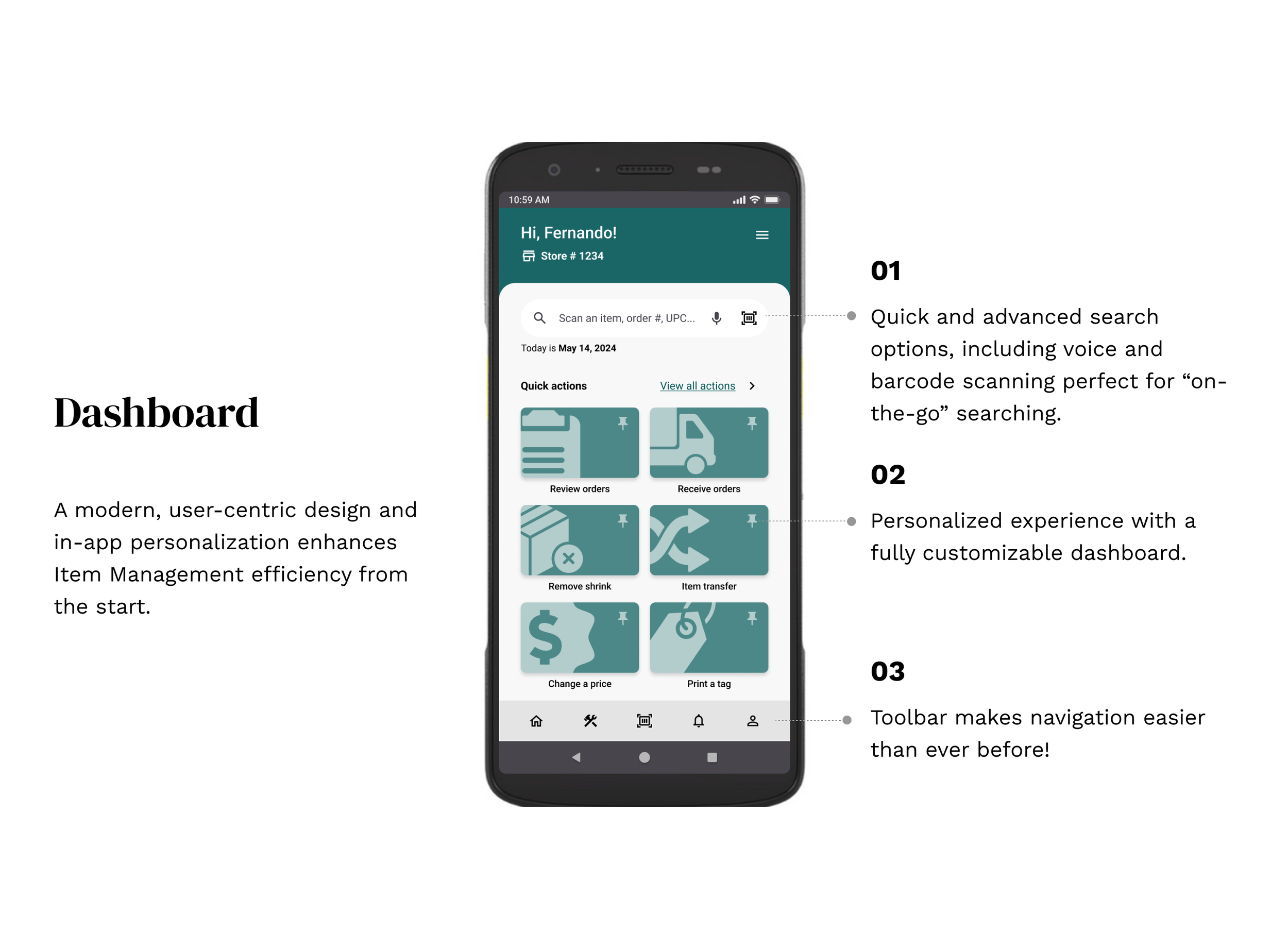
Efficient task completion with dashboard quick actions.
Quick and advanced search options, including voice and barcode scanning, perfect for “on-the-go” searching.
Personalized experience with a customizable dashboard.
Intuitive toolbar for seamless navigation.
-
A streamlined, organized and intuitive workflow makes reviewing orders easy.
Orders are clearly organized by department, taking the guesswork out of order review.
Users can easily customize their view.
Advanced search functionality allows users to look up an order directly.
-
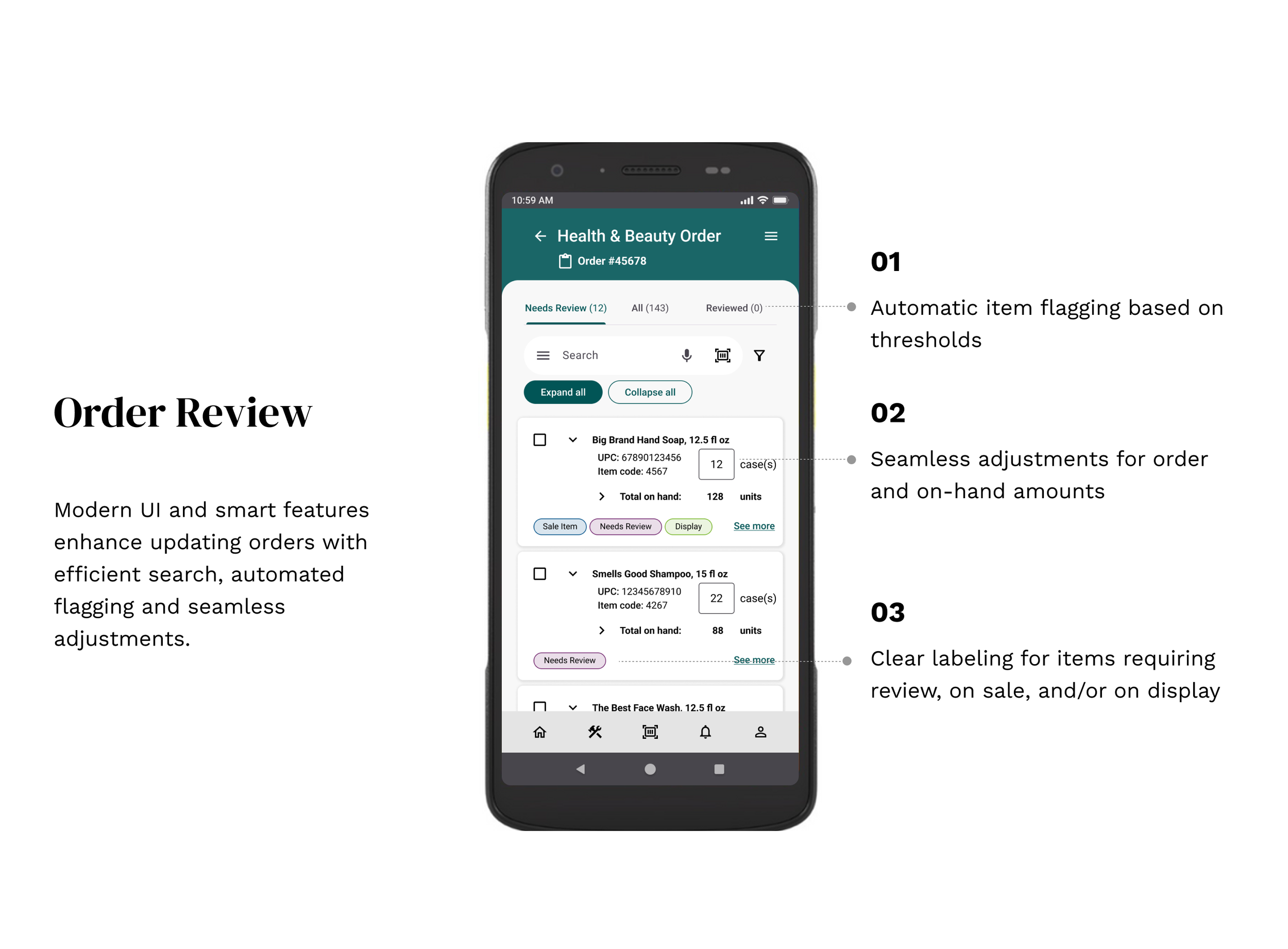
Modern UI and smart features enhance updating orders with efficient search, automated flagging and seamless adjustments.
Automatic item flagging based on established thresholds.
Users can mark an order as reviewed, taking it out of their queue.
Clear labeling for items requiring review, on sale, and/or on display.
Quick item search and results filtering.
Seamless adjustments for order and on-hand amounts.
-
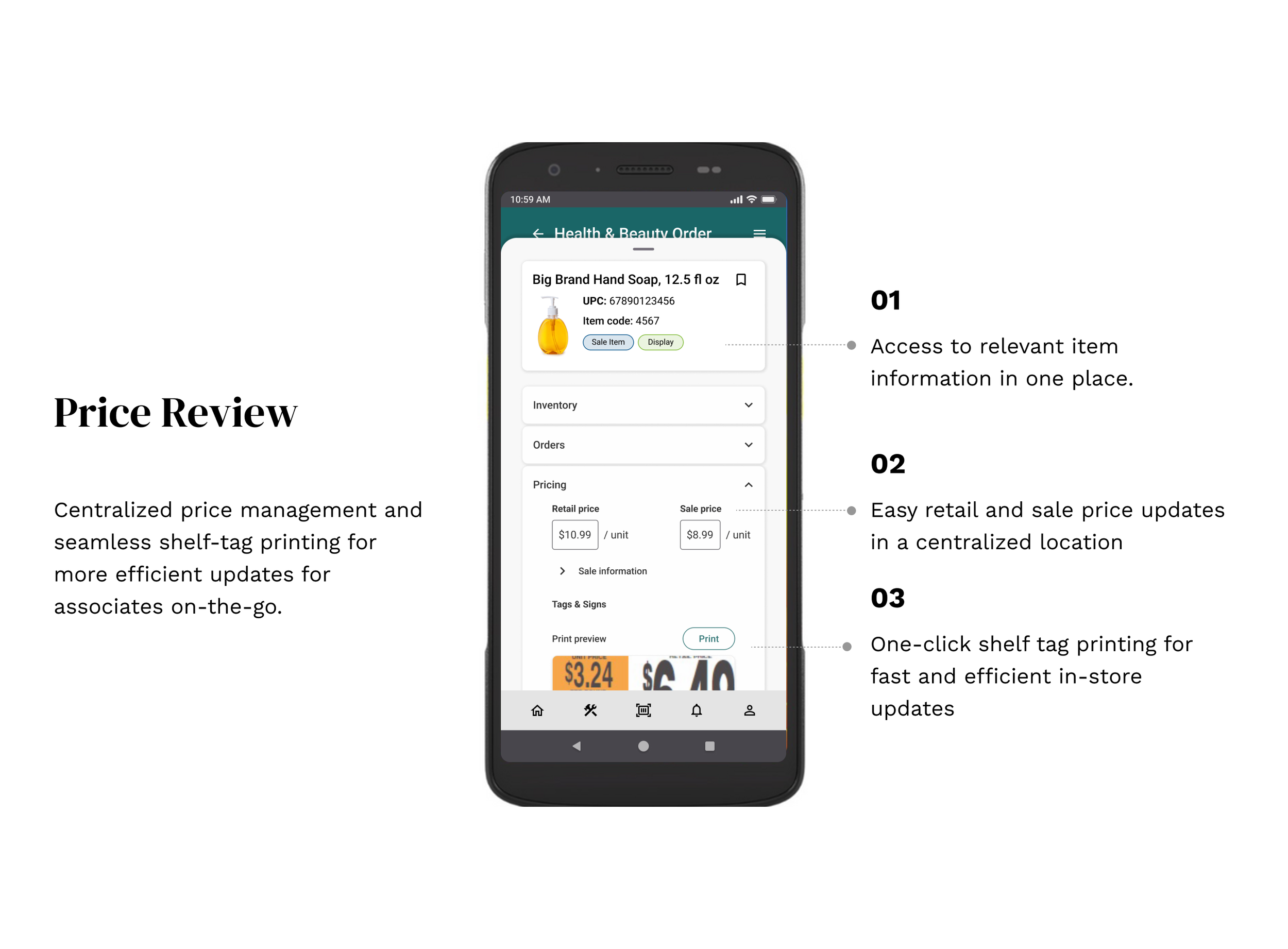
Easy pricing updates in a centralized location.
Quick view of item sale information.
-
One-click shelf tag printing for fast and efficient in-store updates in real-time.
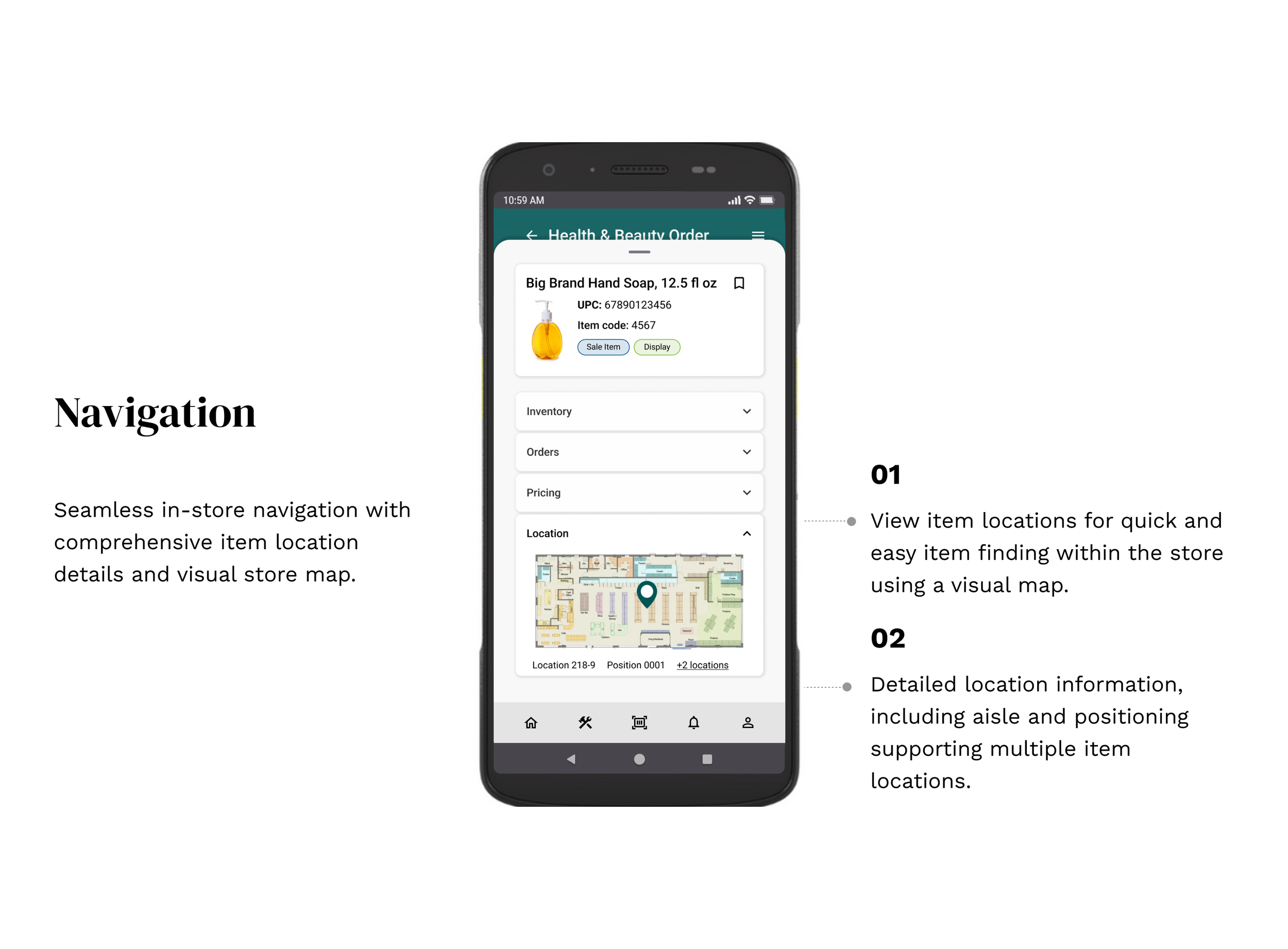
RESEARCH & DISCOVERY
Research uncovered 40+ broken workflows, revealing complex operational realities.
Despite limited access to retail employees, internal political sensitivity, and tight timelines, I led a focused research initiative to uncover the highest-impact opportunities within Item Management.
Conducted 24 in-depth interviews across store and corporate roles surfacing systemic pain points and operational gaps.
Facilitated Jobs-To-Be-Done workshops with brand leaders mapping critical workflows and aligning on business priorities.
Led a five-day collaborative storyboarding sprint establishing a shared vision for a streamlined Item Management experience.
Resolved cross-functional gridlock by facilitating an SME Value vs. Risk prioritization exercise, identifying the most promising areas for prototyping.
Surveyed 100+ store associates to validate SME assumptions and quantify retail pain points.
Leveraged and contributed to Nexus personas to ensure insights consistently inform human-centered decision making.
Key Insights
Successfully navigated HR, legal, and union constraints ensuring frontline voices were represented in the research.
“Item Management” was not a single workflow but more than 40 fragmented processes across the organization requiring harmonization.
Stakeholder assumptions about priorities were proven to be misaligned with frontline reality:
Receiving, ranked as the top issue by stakeholders, accounted for only 7% of friction.
In-aisle tasks drove the majority of pain, including Tags & Signs (31%), Ordering (23%), and Item Transfers (18%).
Strategic Decisions & Trade-offs
Using research data as evidence, I reframed the team’s focus to prioritize areas of greatest frontline impact.
Pivoted design efforts toward in-aisle workflows, despite internal pressure to prioritize previously assumed stakeholder priorities such as receiving.
Anchored product direction in validated user insights, helping shift decision making from assumption-driven to evidence-based prioritization.
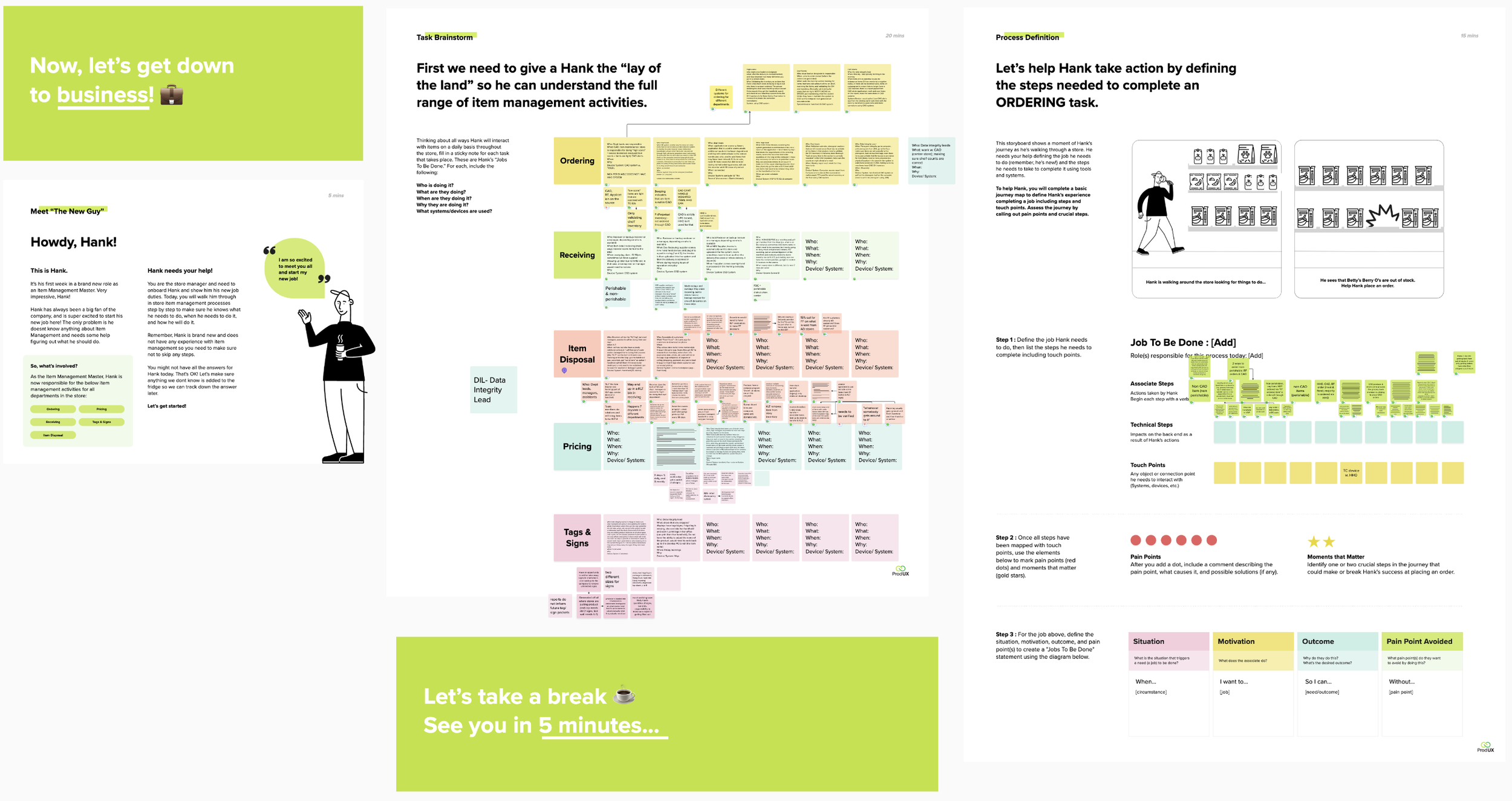
We conducted A Jobs To Be Done (JTBD) workshop to identify critical workflows and areas of opportunity.
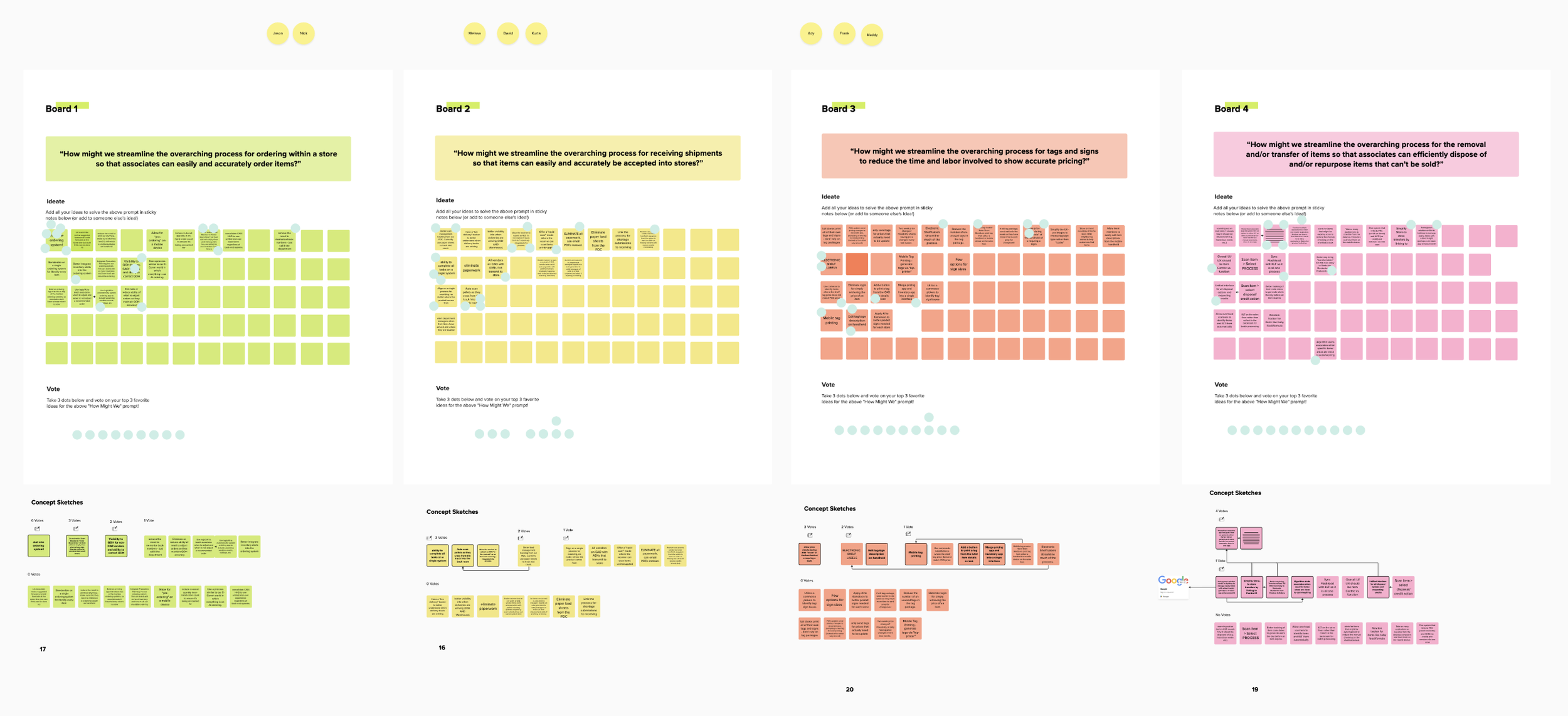
We kicked off our storyboarding sprint with a Round Robin ideation session with stakeholders.
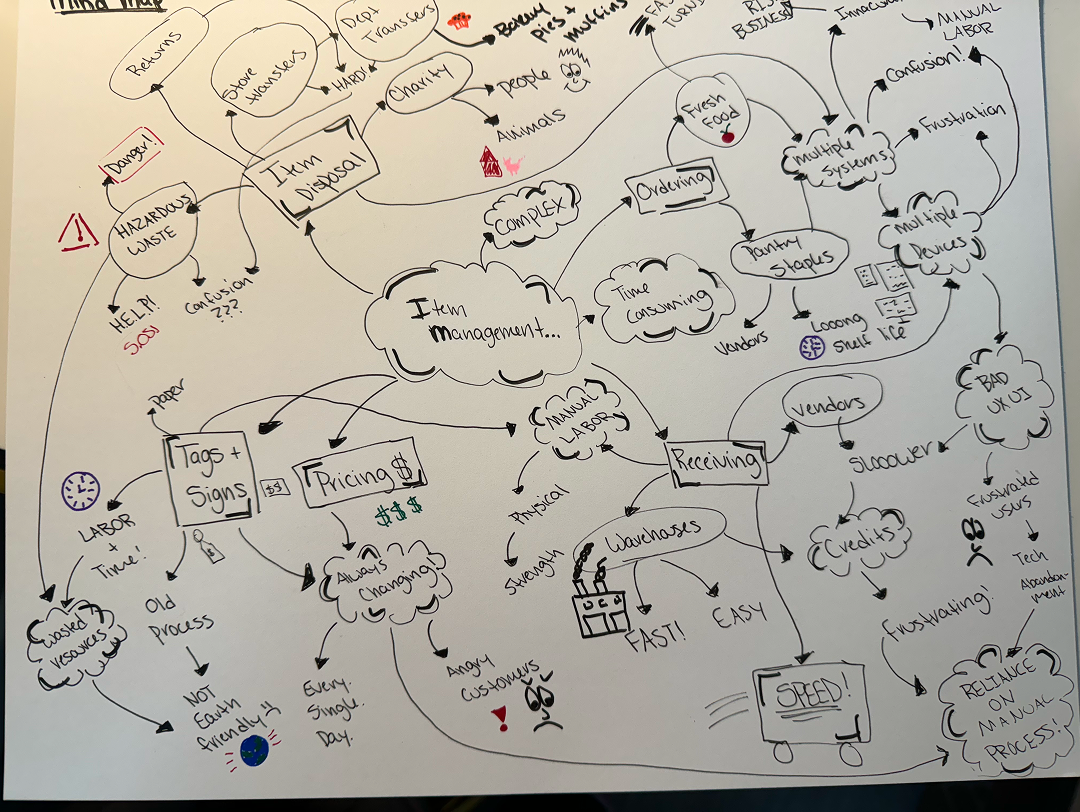
Mind maps helped visualize all the information we had learned during research to illustrate commonalities & connections.
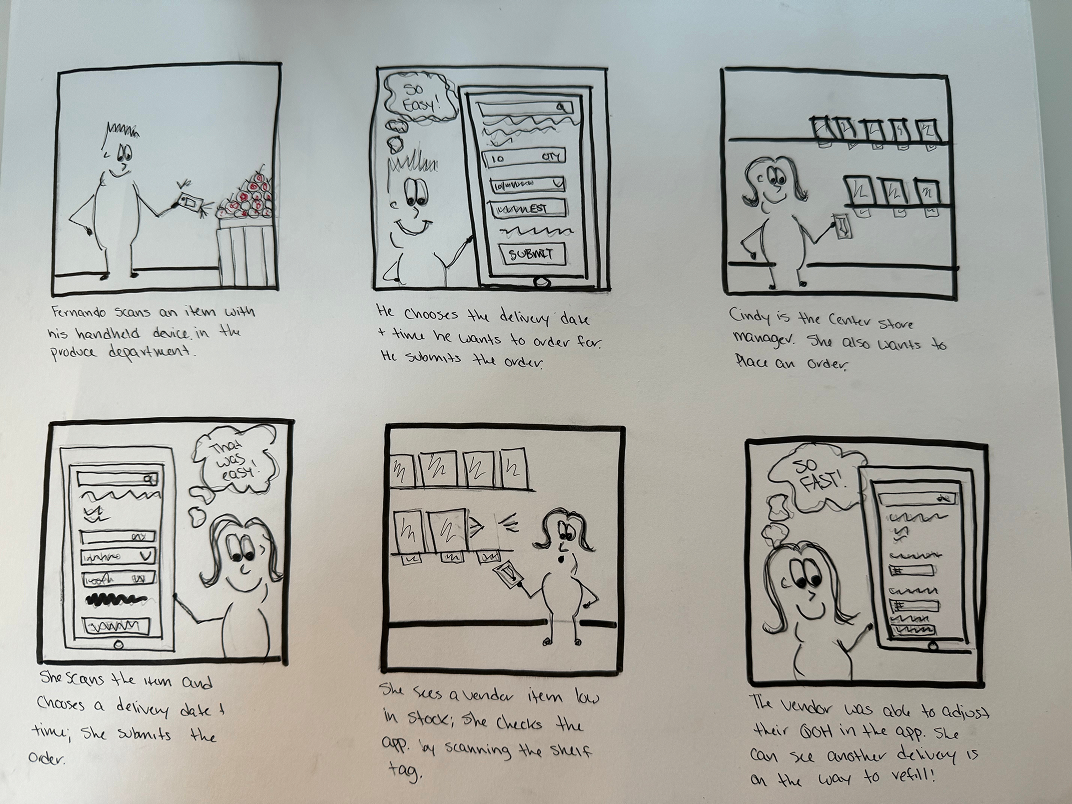
We sketched low-fidelity concepts of the best ideas resulting from ideation.

We iteratively drafted storyboards, getting feedback from stakeholders after each iteration.

We ended the sprint with a final, polished storyboard.
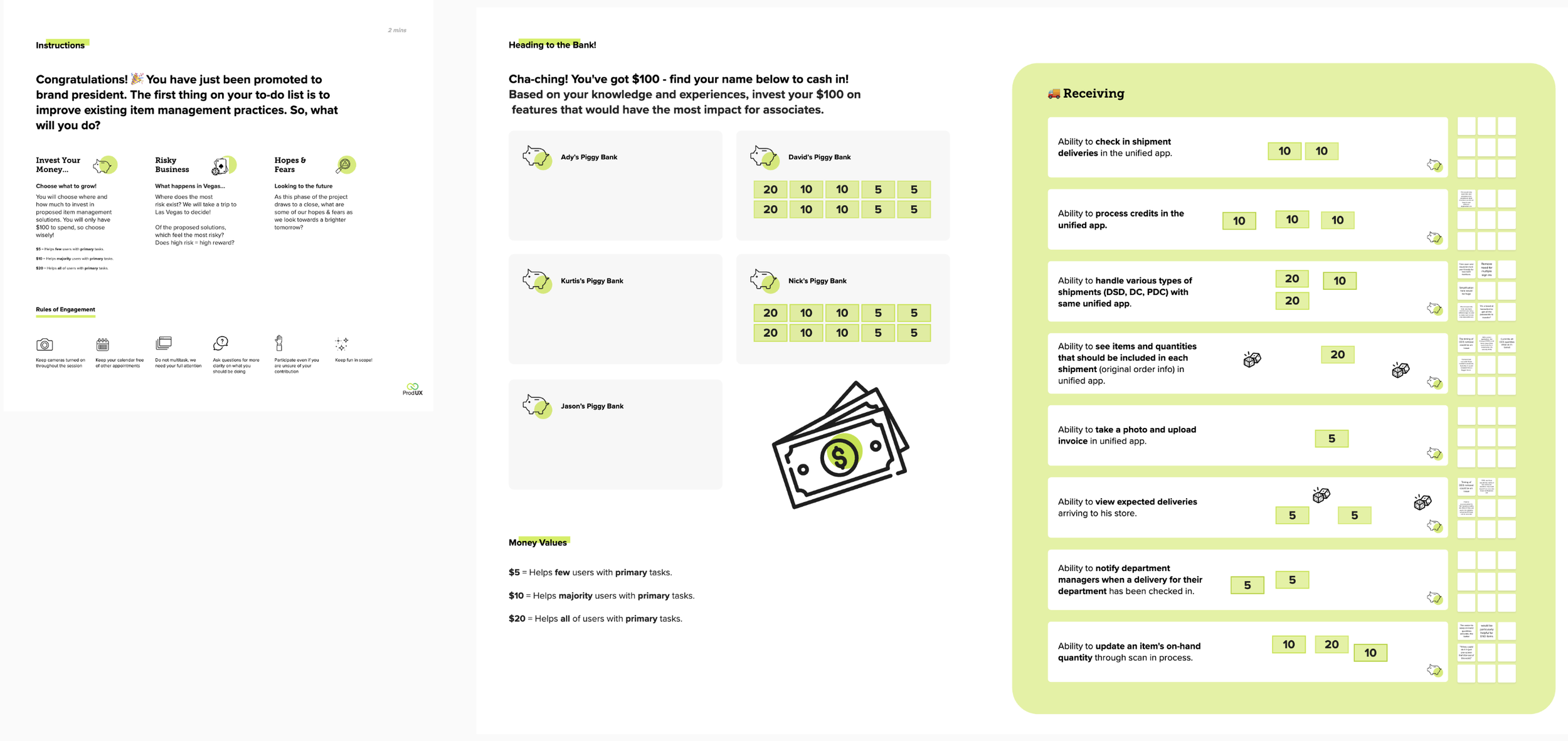
We used the storyboard to facilitate a Value vs. Risk workshop, a fun approach to feature prioritization.
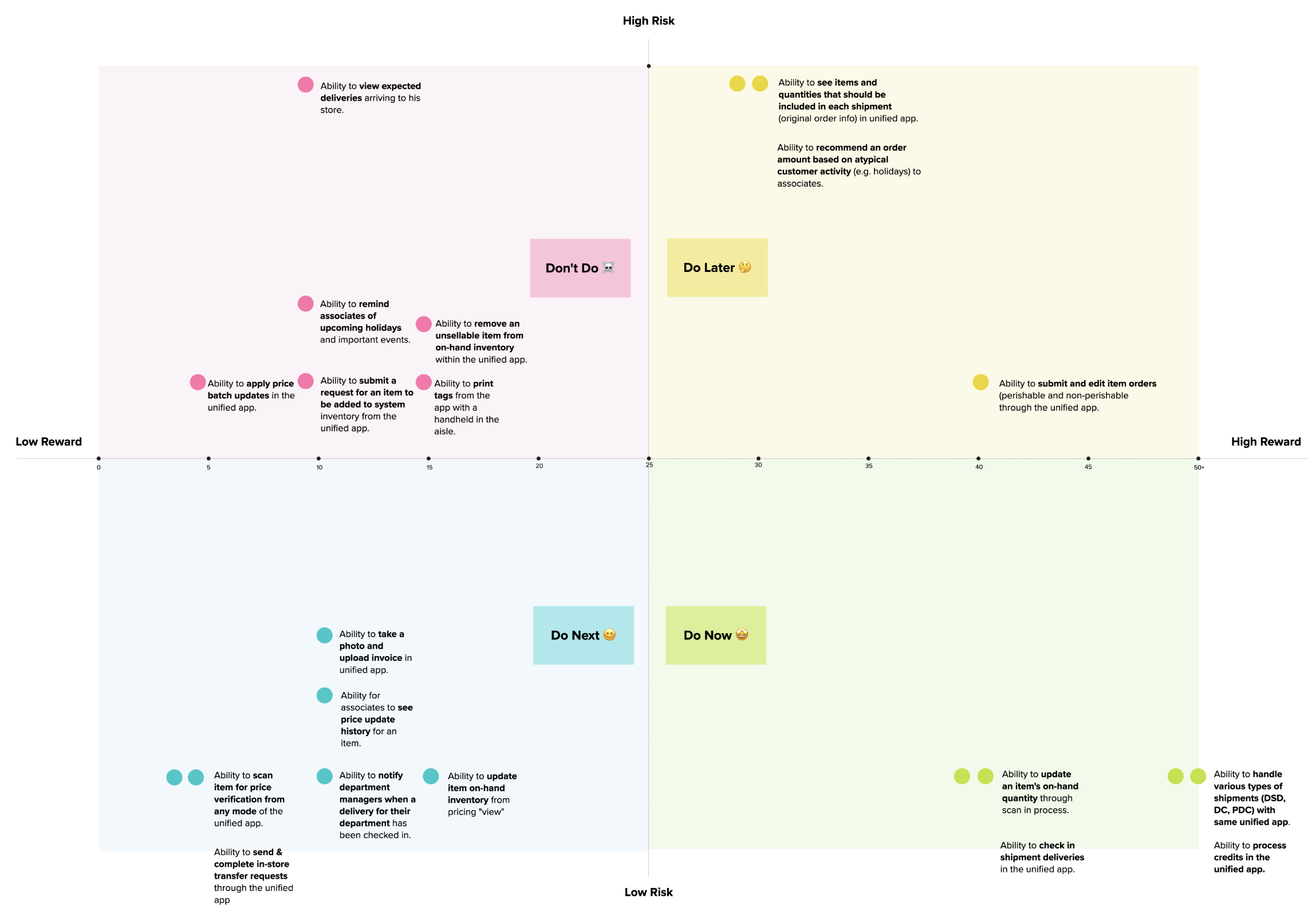
We leveraged a prioritization matrix to plot results of the Value vs. Risk workshop, defining clear focus areas for further work.
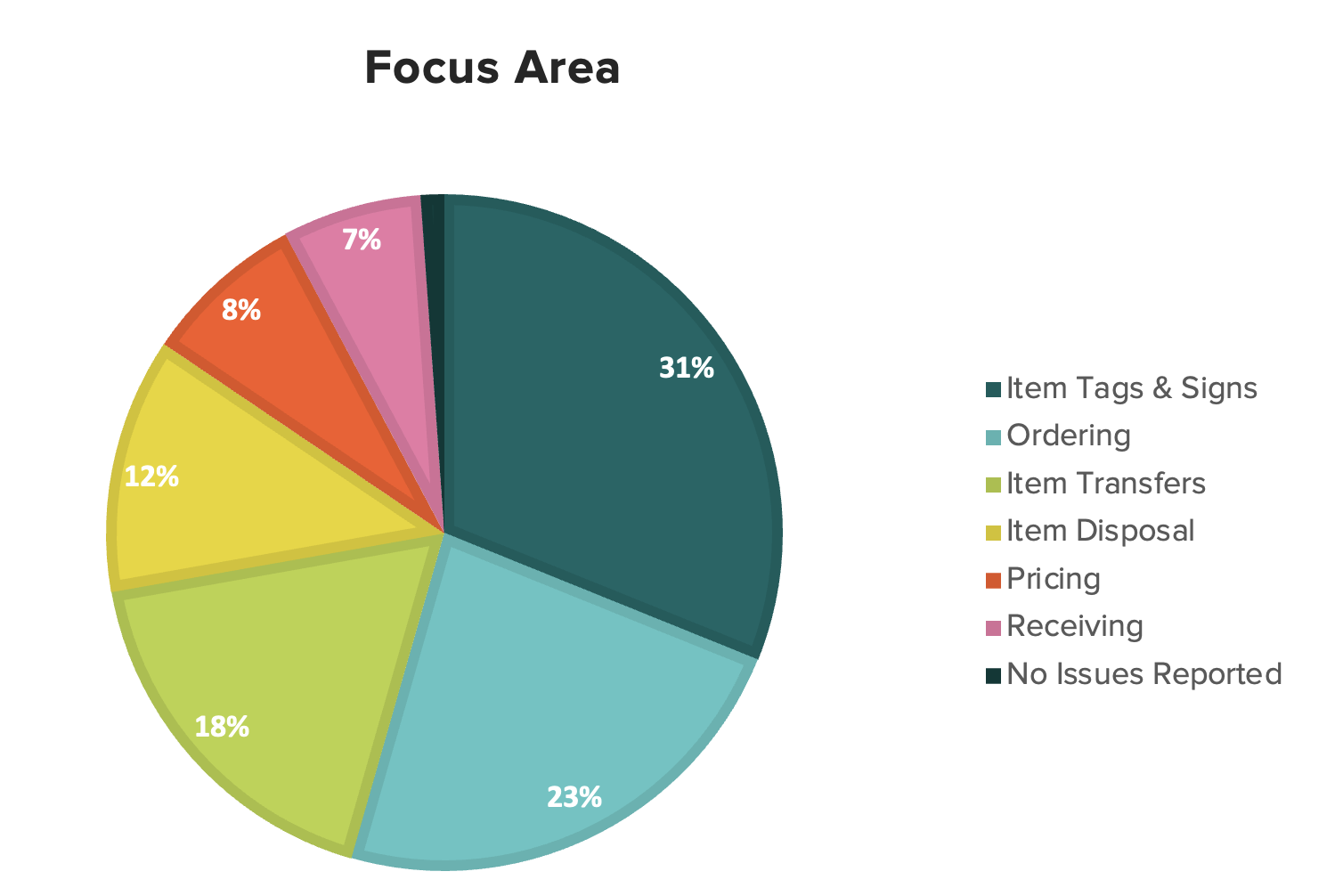
Lastly, we surveyed 100+ associates (end-users) and validated final areas of focus for prototyping during a second design sprint.
DESIGN, PROTOTYPE & TEST
Co-design helped balance usability and complexity through iterative prototyping & testing.
Using research insights as the foundation, I led a collaborative sprint-based design process to translate findings into a tangible vision for a streamlined Item Management experience. Co-creation with subject matter experts, engineers, and end users ensured the concept balanced operational realities with real user needs.
Led a second five-day design sprint focused on translating storyboard concepts into interactive prototypes.
Facilitated daily co-design sessions with SMEs, engineers, and end users, iterating rapidly across multiple levels of fidelity.
Developed a high-fidelity conceptual prototype to bring a unified Item Management workflow to life.
Key Insights
Design sprints successfully aligned five brands’ operational complexity into a single shared vision for Item Management workflows quickly.
Involving engineering directly in the co-design sessions helped validate technical feasibility early, reducing downstream risk.
The intensity of the sprint revealed the need for more sustainable pacing for the design team during extended collaboration cycles.
Strategic Decisions & Trade-offs
Insights from testing and co-creation informed several critical prioritization decisions.
Reprioritized tag printing workflows (previously deprioritized by SMEs) after end-user testing revealed significant friction.
De-scoped high-risk concepts such as real-time automation and order tracking due to technical feasibility and governance constraints.
Used progressive disclosure to balance simplicity and operational utility within complex workflows.
Identified a process gap: quantitative usability metrics were not captured during sprint testing, limiting measurable validation.
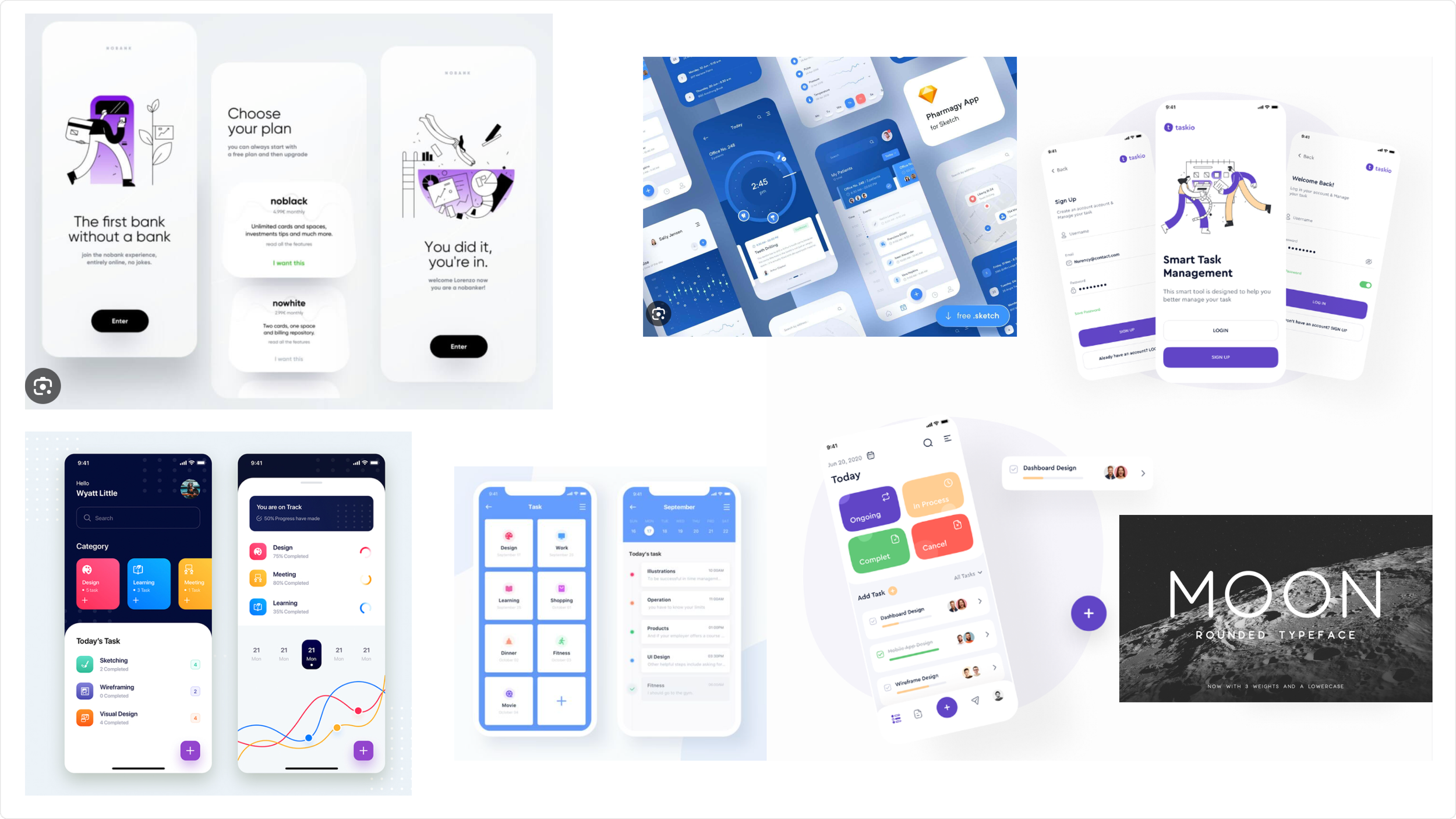
We kicked off our second design sprint by creating inspiration boards to guide the overall design direction.
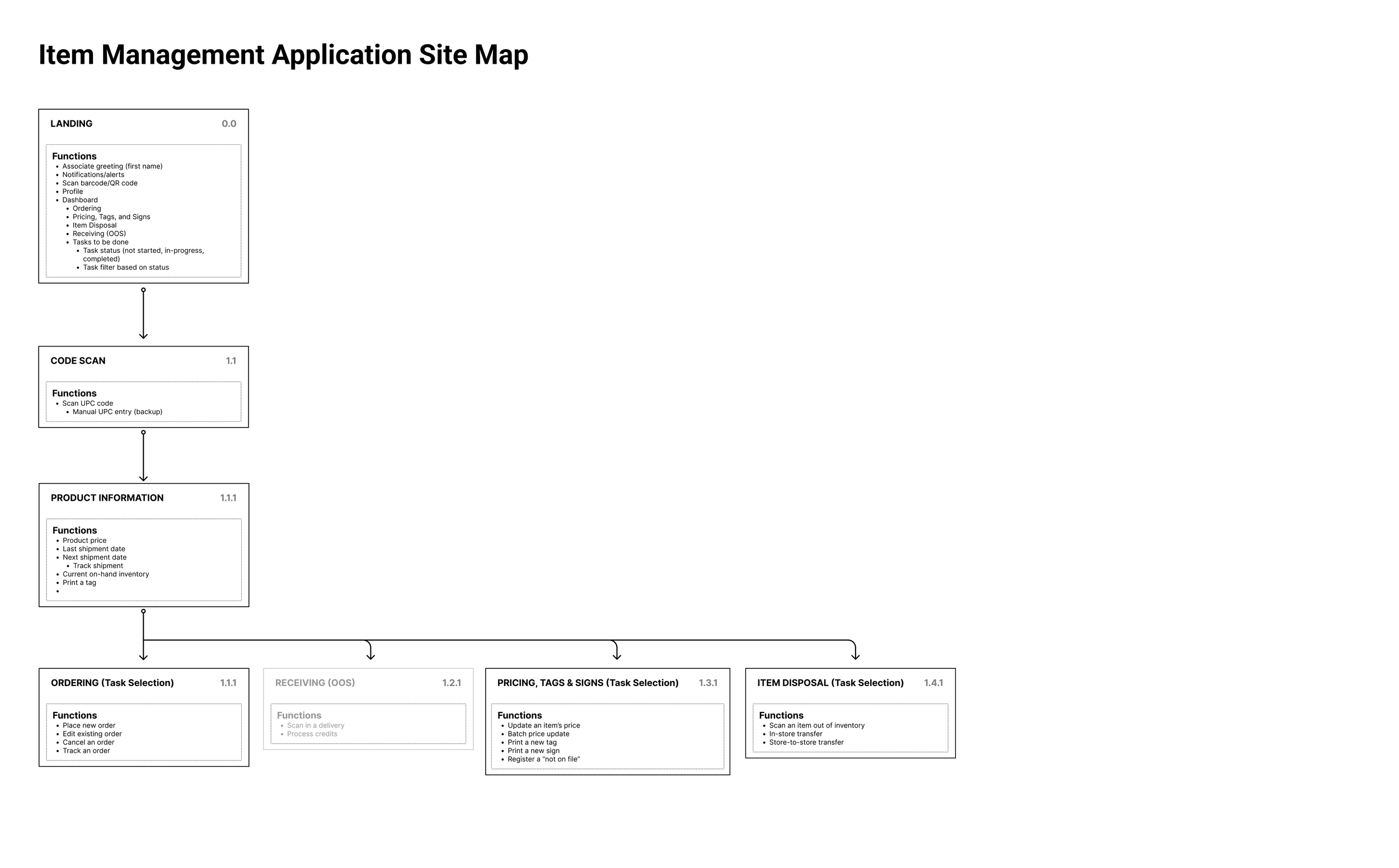
We defined the foundational information architecture by creating a high-level structural sitemap.
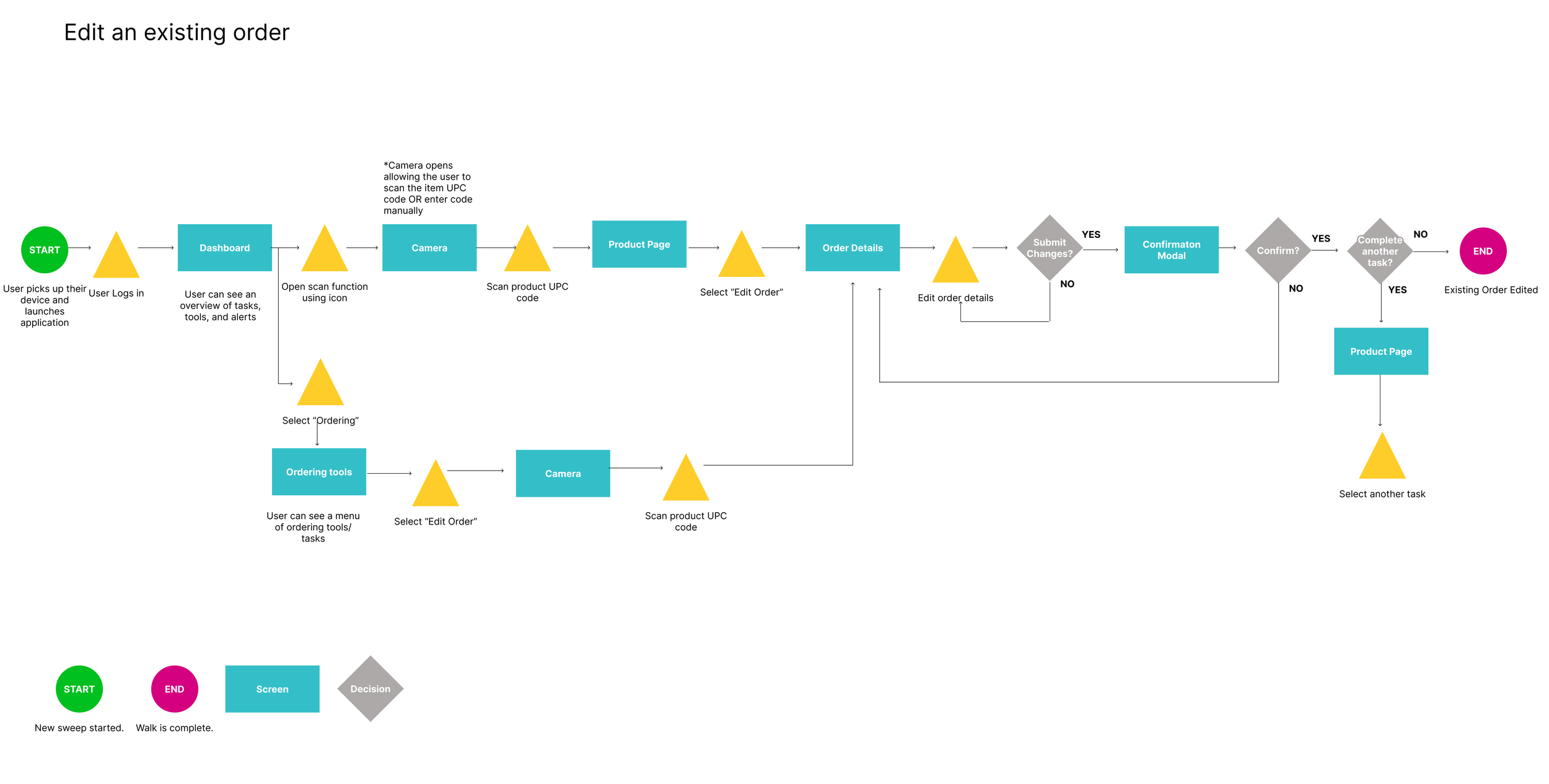
We created user flows for key tasks: Ordering, In-Aisle Tag Printing, & Item Disposal.
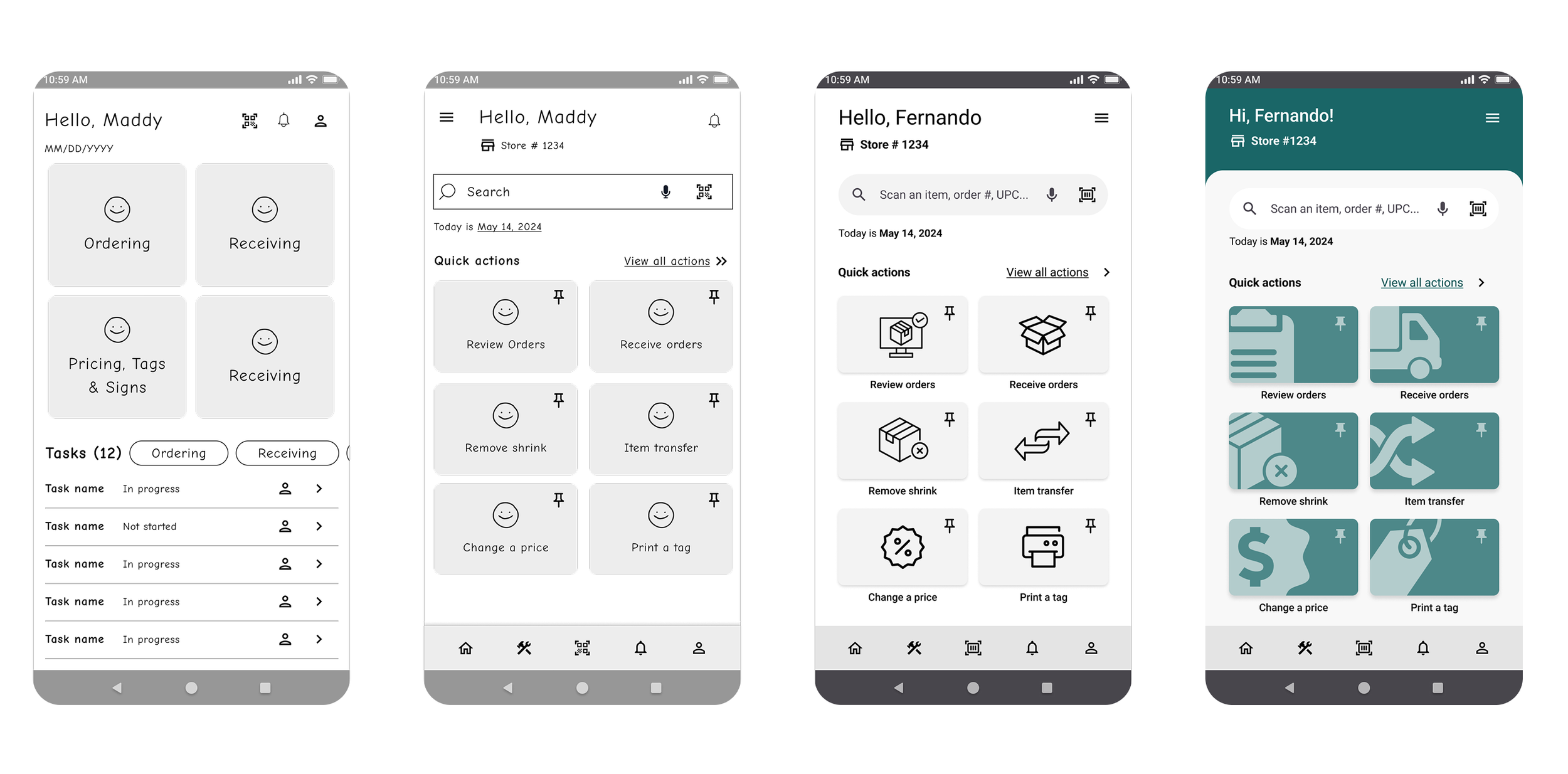
We rapidly co-designed, tested and iterated with end-users moving from low to high fidelity.
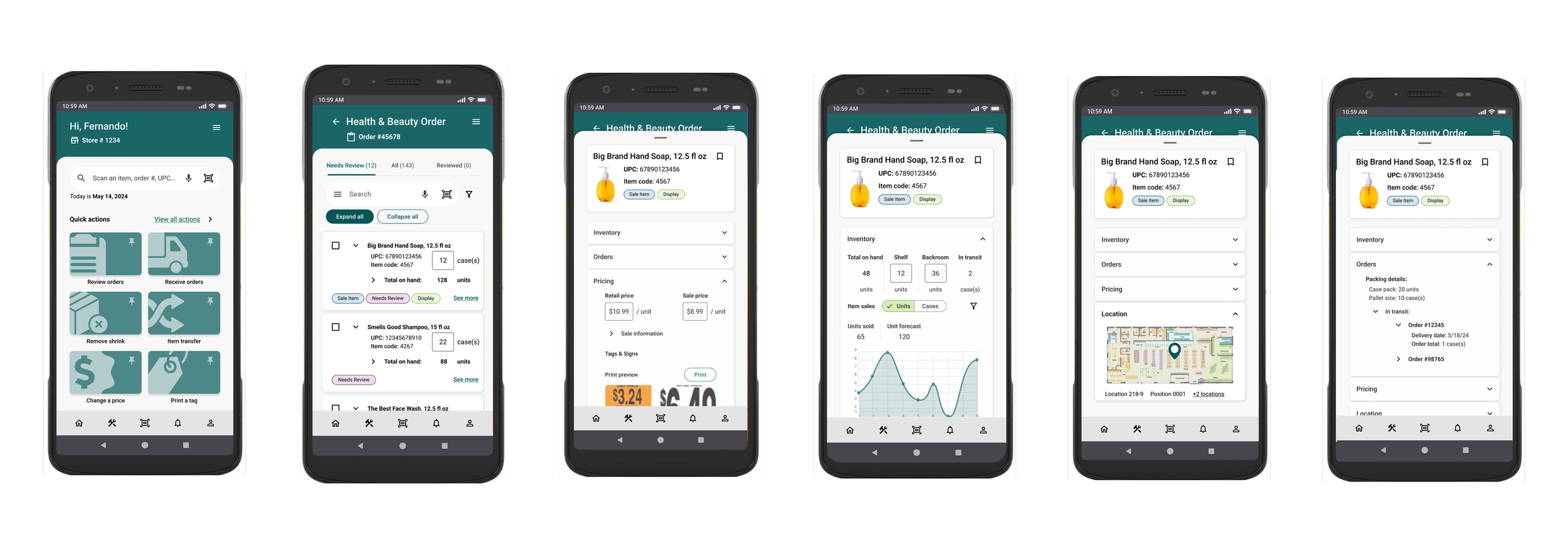
By the end of the sprint, we had a polished, clickable, high-fidelity prototype of prioritized features.
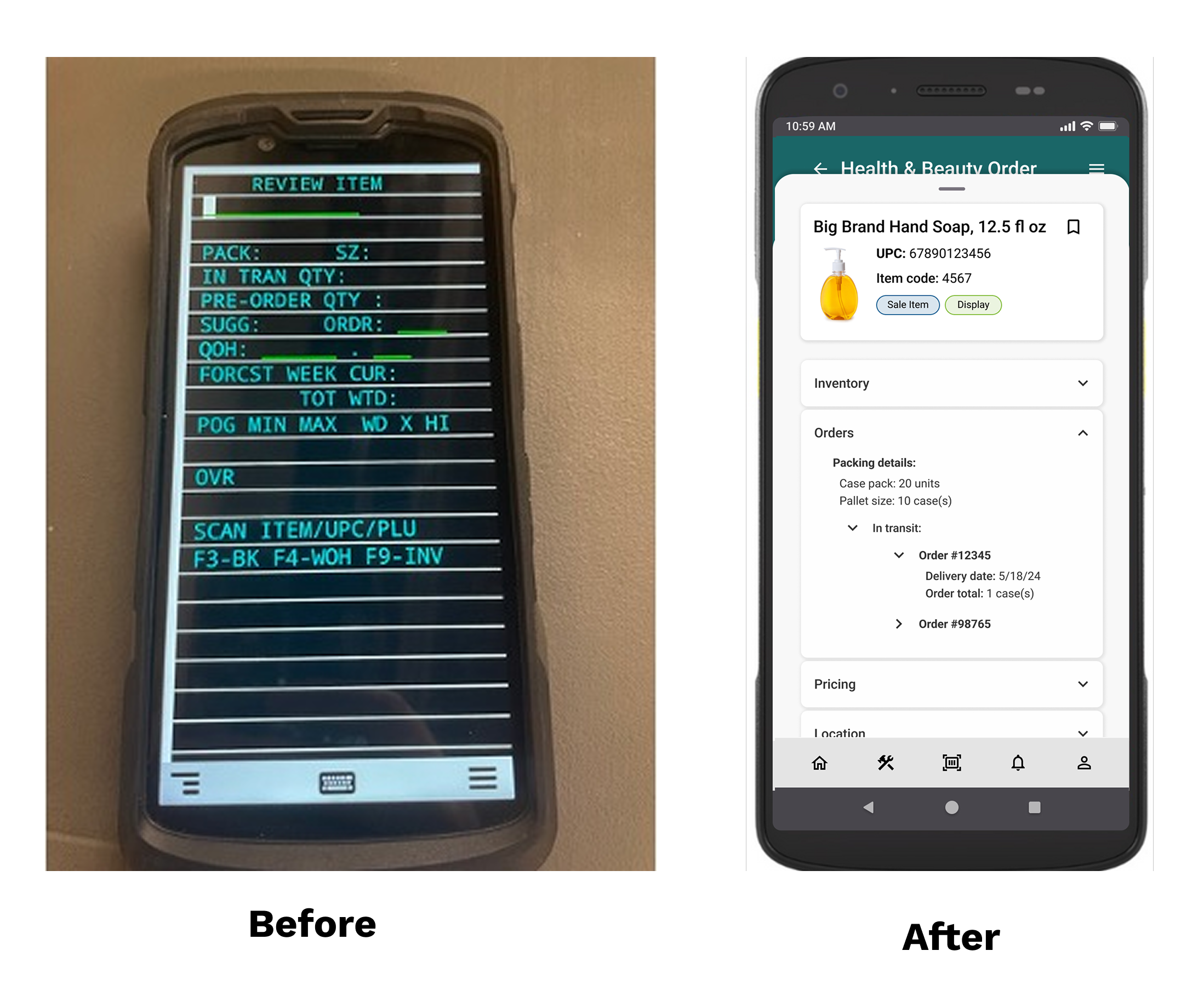
The prototype made the shared future-state workflow tangible, enabling teams to evaluate a common modernization direction across brands.
Despite sprint challenges and operational complexities, Item Management proved the power of human-centered design at scale.
RESULTS & IMPACT
A unified, tangible, future-focused vision driving multi-million dollar business decisions.
The future-state concept aligned five brands around a shared Item Management vision and now informs a multi-year, multi-million-dollar modernization strategy grounded in validated frontline research and workflow needs.
Impact
All five brands aligned on a single, streamlined workflow vision for Item Management, reducing operational complexities and costs.
Guiding a multi-year, multi-million dollar investment strategy and roadmap grounding decisions in validated research and subsequent prototyping.
Early clarity informed backend sizing and compliance planning reducing engineering risk and overhead.
Evidence-based prioritization prevented downstream rework avoiding high-cost inefficiencies.
Key Lessons
Design sprints require intentional pacing and sequencing to prevent team burnout during intense collaboration cycles. Pace is an important consideration to ensure high quality outcomes.
Expert assumptions must earn their place through evidence, even with contribution and support from highly knowledgeable stakeholder groups.
Establish quantitative success metrics early to track adoption, iterative progress and validate outcomes.
Early engagement with cross-functional teams (especially engineering and SMEs) ensures feasibility and alignment for complex, enterprise-scale workflows and systems.
Next Steps
The prototype is actively informing a broader phased rollout of the modernization effort, with iterative refinement planned to continuously improve workflows and ensure scalable adoption.
-
Intuitive, modern design and smart features.
Intuitive design, smart features, and streamlined workflows transform Item Management, boosting efficiency, decision-making, and the associate experience.
-
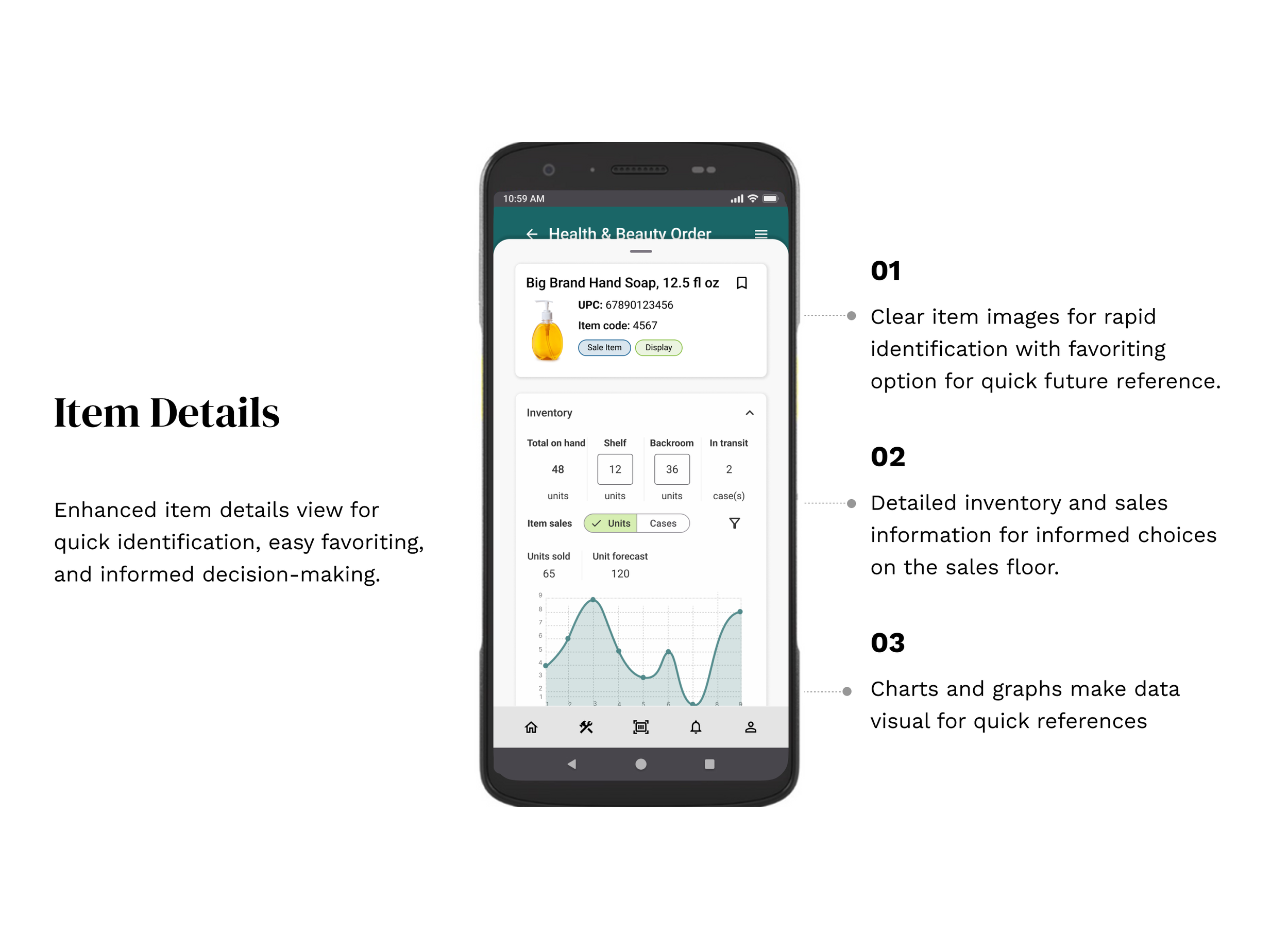
Simplified ordering and inventory adjustments.
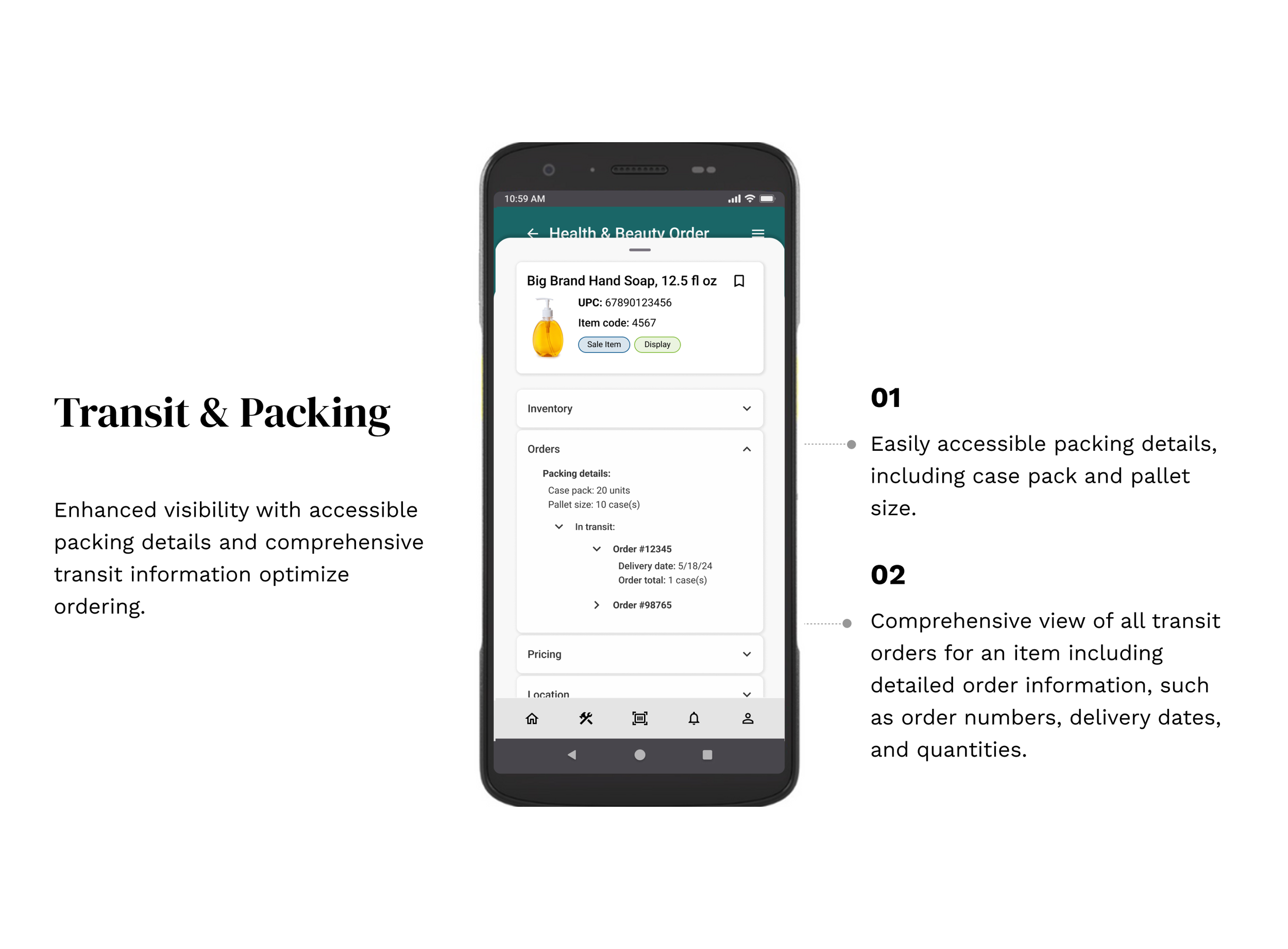
Enhanced visibility with accessible packing details and comprehensive transit information optimize ordering.
-
Optimized pricing with in-aisle tag printing.
Retail and sale prices centrally managed with quick access to item sale information. One-click shelf tag printing increases efficiency and price accuracy.
Continue the journey by reading these related case studies.
-
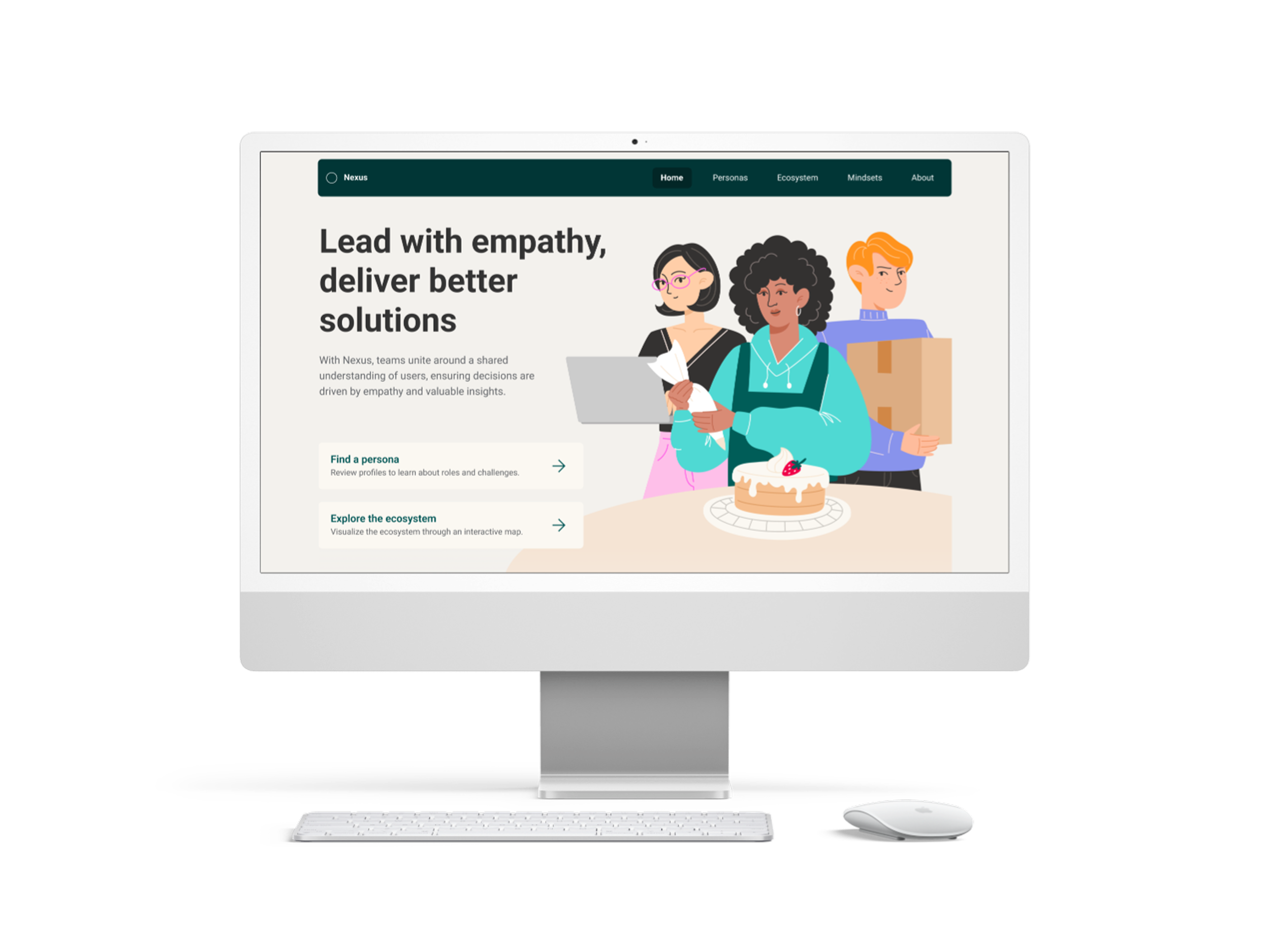
Reveal: Nexus Persona Ecosystem
Turn research into shared understanding.
I built and activated an enterprise ecosystem of 30+ validated personas, supported by AI-enabled research workflows, training, activation tools, and a maturity framework that embeds insight into everyday decision-making.
-
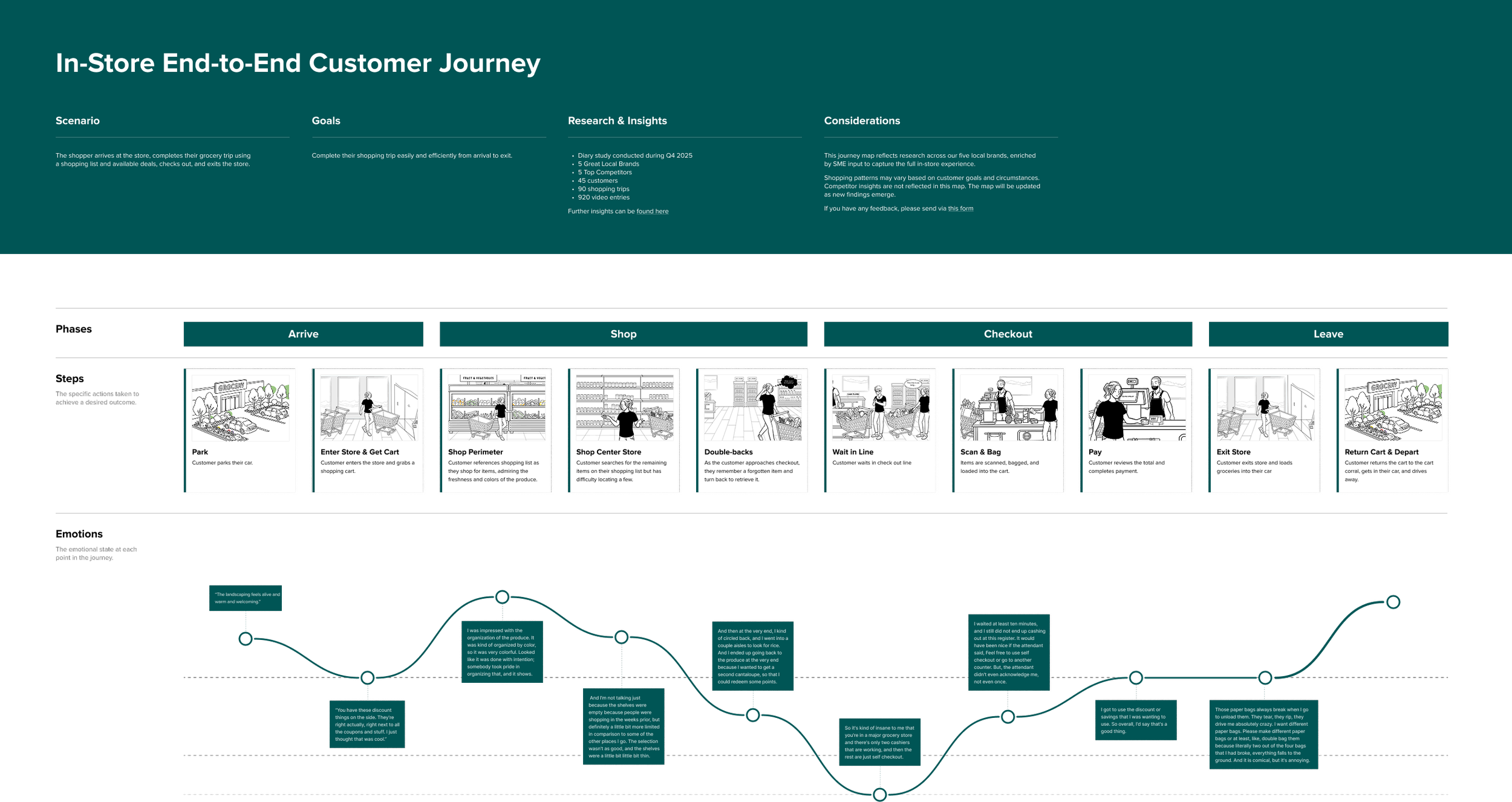
Translate: Enterprise Journey Management
Create a shared view of the end-to-end experience.
I established and lead the organization’s foundational Journey Management capability, connecting customer journeys, associate service blueprints, and scalable governance to uncover systemic gaps and inform experience strategy.
-
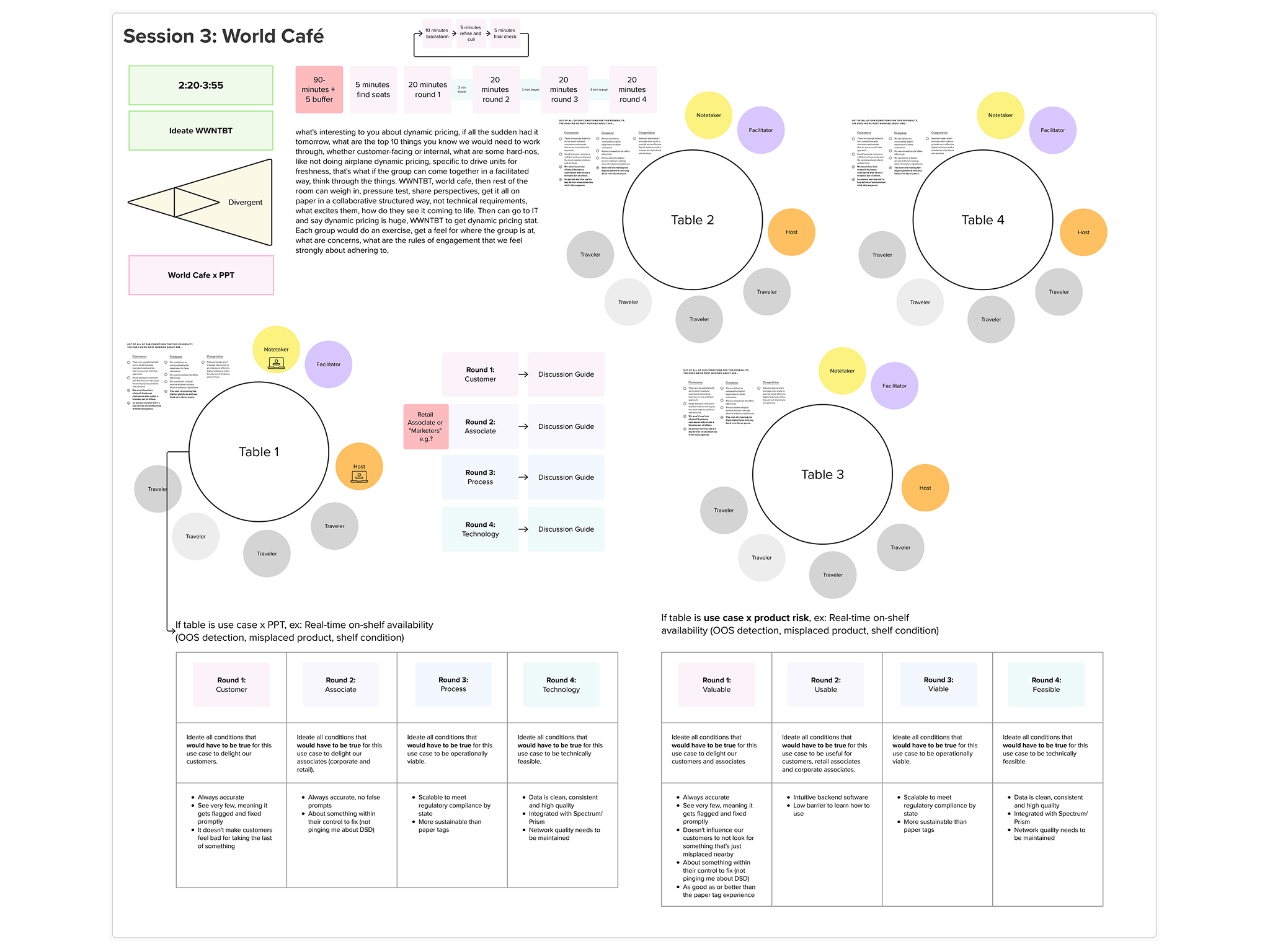
Enable: Executive Visioning & Alignment
Turn complexity into shared direction.
I designed and facilitated a high-stakes executive alignment workshop across brands and business functions, breaking more than a decade of stalled progress to align leaders on a shared Electronic Shelf Label pilot direction.