CASE STUDY
End-to-End Journey Framework & Customer Journey Mapping
Bringing Together Customer and Associate Experiences to Reframe Omni-Channel Decisions
Domain: Enterprise Service Design (B2E)
Timeline: Ongoing
Role: Lead Service Designer, Journey Strategy & Practice Lead
Process Phase: Translate
JOURNEY FRAMEWORK & MAPPING
Table of Contents
Project background, core challenges to solve, and my role.
Definition of the project goal, key guiding questions, and success criteria.
High-level introduction to the proposed solution and overall strategic direction.
Overview of broader strategic thinking and early journey framework definition.
Summary of research methods, insights gathered, and key findings that informed design direction.
Description of the iterative design process across multiple levels of fidelity.
Explanation of collaborative co-mapping, activation activities, and stakeholder engagement.
Presentation of outcomes, impact and key learnings.
Links to related work case studies.
SITUATION
Without an understanding of the in-store journey, siloed initiatives were creating broken customer experiences.
The in-store customer experience was often discussed in terms of isolated touch points or operational processes, with no shared understanding of the end-to-end journey or how store operations supported it.
Challenges
No consistent way to see or manage the end‑to‑end in-store experience across the experience ecosystem.
Disconnected customer, associate, and operational perspectives led to siloed decisions and broken experiences in stores.
Multiple stakeholders with competing priorities lacked a shared source of truth to align strategy and execution.
Maps needed to be coordinated across five brands while supporting both strategic direction and tactical delivery.
Constraints
Limited existing journey artifacts or documentation.
Artifacts needed to remain flexible and iterative rather than feel “final.”
Limited leadership buy-in and funding.
My Role
I introduced journey mapping by defining and delivering a scalable framework and leading cross‑functional synthesis of research and operational insights. I led a team to create foundational journey maps that connect customer and associate experiences, establishing the organization’s journey management foundation.
Team: 1 Design Manager, 2 Experience Designers, 2 UX Researchers
“How might we create an evidence-backed, end-to-end view of the in-store customer journey across touch points to guide aligned omni-channel strategy?”
TASK
Leverage an end-to-end journey view to drive smarter omni-channel decisions.
Goal
Connect customer behaviors, associate interactions, and operational workflows by establishing a scalable journey framework and the organization’s first end-to-end maps of the in-store customer experience to influence omni-channel strategy.
Key Questions
How can we visualize the full shopping trip from the customer perspective?
How do store associates support customers throughout the in-store journey?
Where do friction points occur across the experience?
How can we establish an omni-channel perspective to break long held organizational silos?
How can journeys be structured so they remain scalable?
Success Criteria
Establish a scalable journey framework.
Produce foundational journey maps that reveal friction points and opportunities.
Incorporate supporting operational workflows and associate behaviors.
Enable teams to identify opportunities for experience improvements.
SOLUTION PREVIEW
A shared journey framework established the foundation for end-to-end experience planning and Journey Management.
This work introduced journey mapping to the organization by establishing a scalable journey framework and creating the first journey maps of the in-store customer experience.
Impact: Connected customer, associate, and operational perspectives through a scalable framework that reveals experience gaps and creates a common foundation for future journey-led planning and decision-making.
-
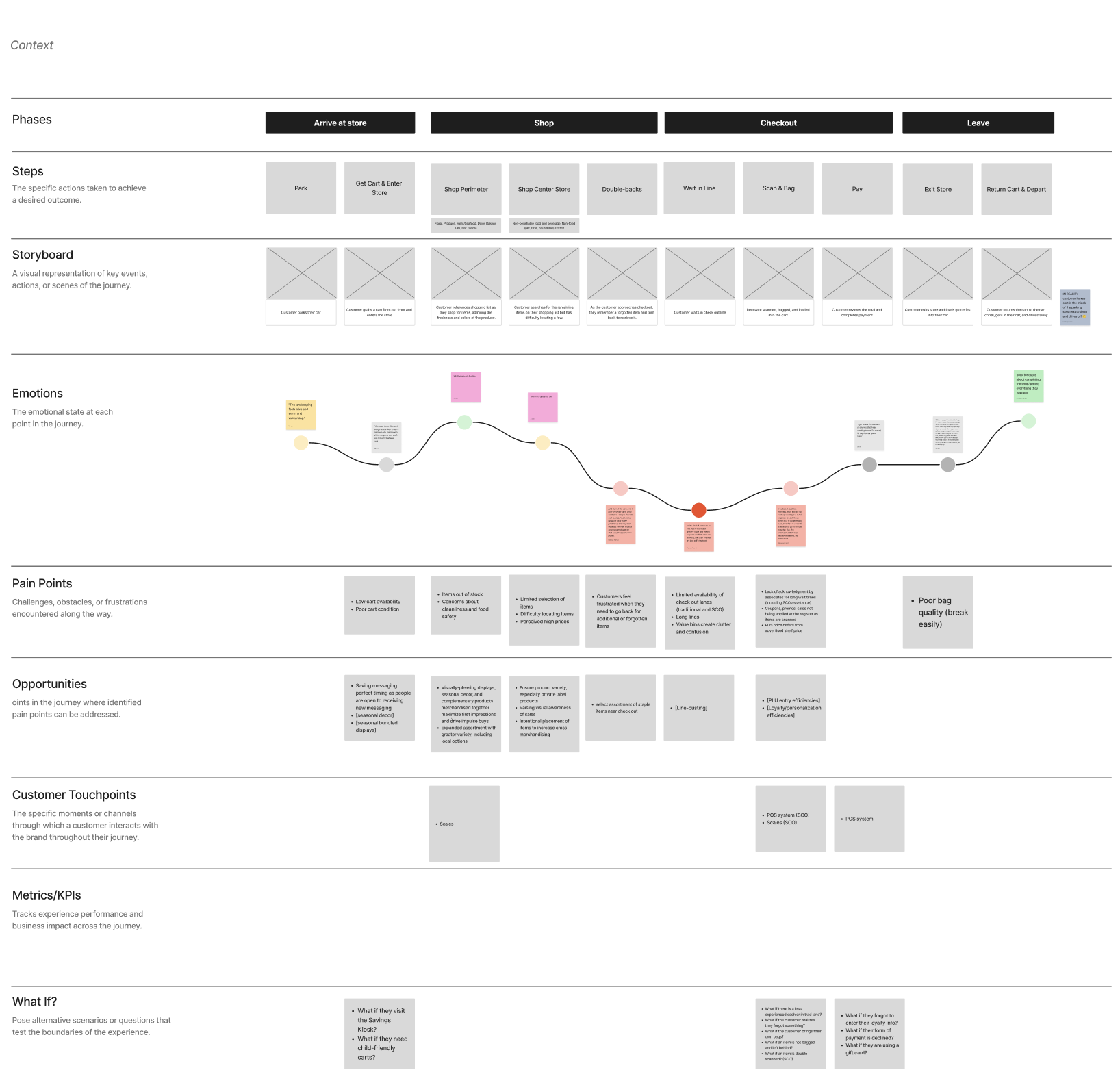
A structured model defining how journeys should be mapped across multiple levels of detail.
The framework establishes
A consistent journey hierarchy
A repeatable structure for standardized mapping
Impact
Created a scalable foundation for journey mapping enabling teams to explore experiences consistently across the organization.
-
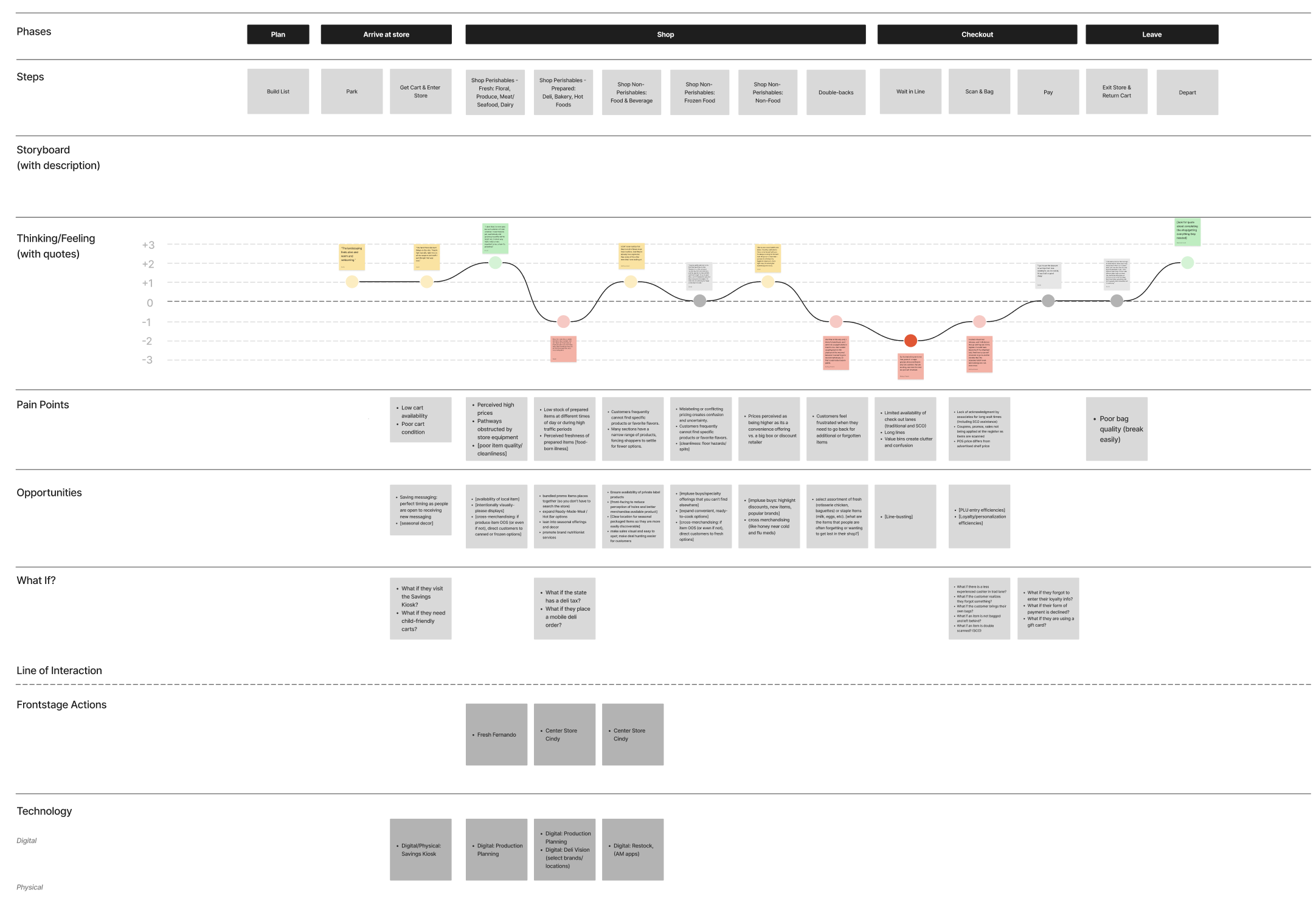
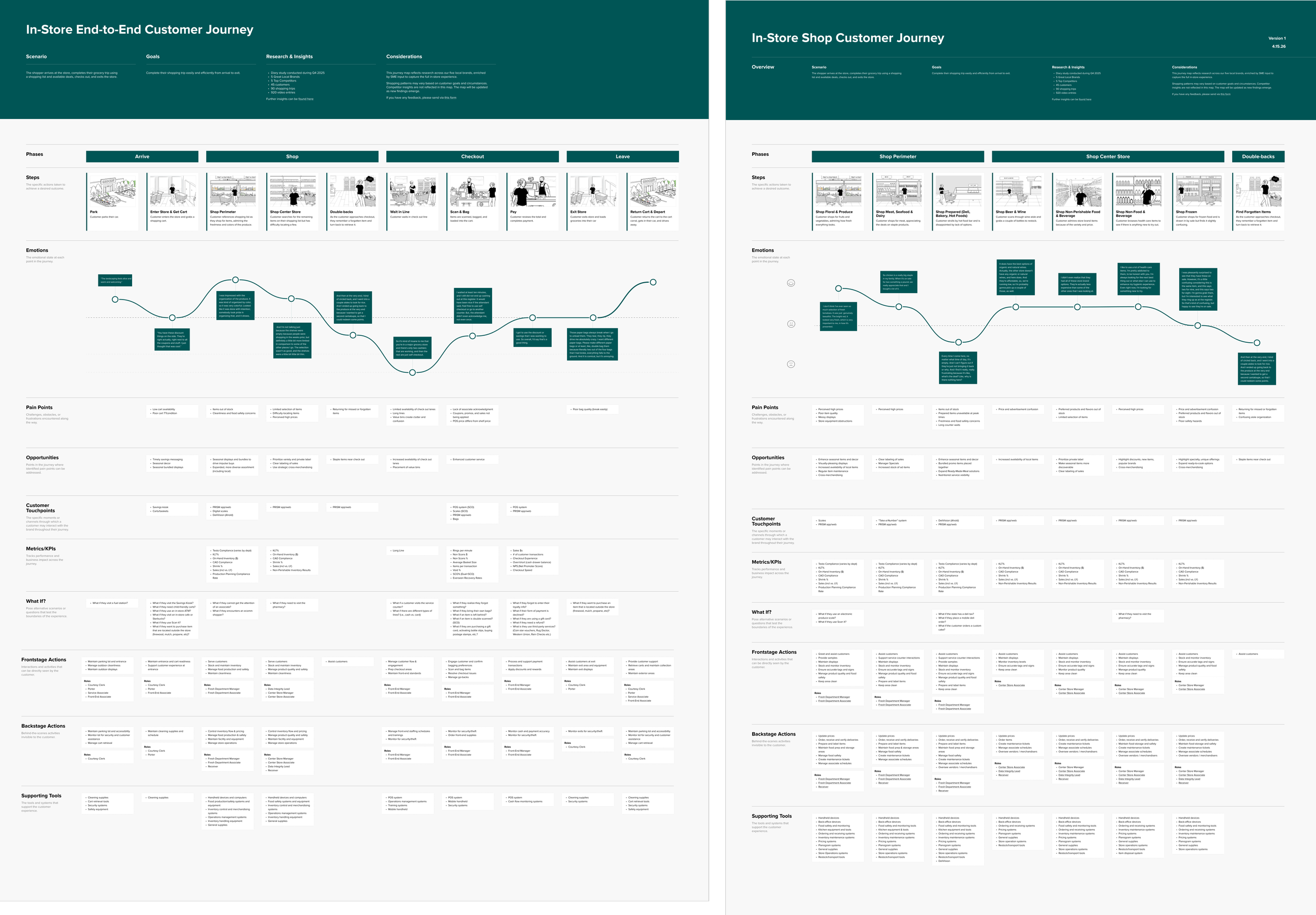
A high-level map captures the full in-store grocery journey from arrival through departure.
The map visualizes
Major journey stages & steps
Storyboard
Emotional highs and lows
Customer pains and opportunities
Customer touchpoints
Metrics/KPI’s
What If (for capturing “unhappy paths” and journey pivots)
Impact
Provides the organization’s first holistic view of the end-to-end in-store experience revealing systemic friction points and enhancement opportunities.
-
A deeper exploration of the shopping portion of the journey focused on selecting products within the store’s perimeter and center aisles.
The map details
Shop specific journey stages & steps
Storyboard
Emotional highs and lows
Customer pains and opportunities
Customer touchpoints
Metrics/KPI’s
What If (for capturing “unhappy paths” and journey pivots)
Impact
Provides deeper context into intricate behavioral insights and strategic opportunities within specific store departments and aisles.
-
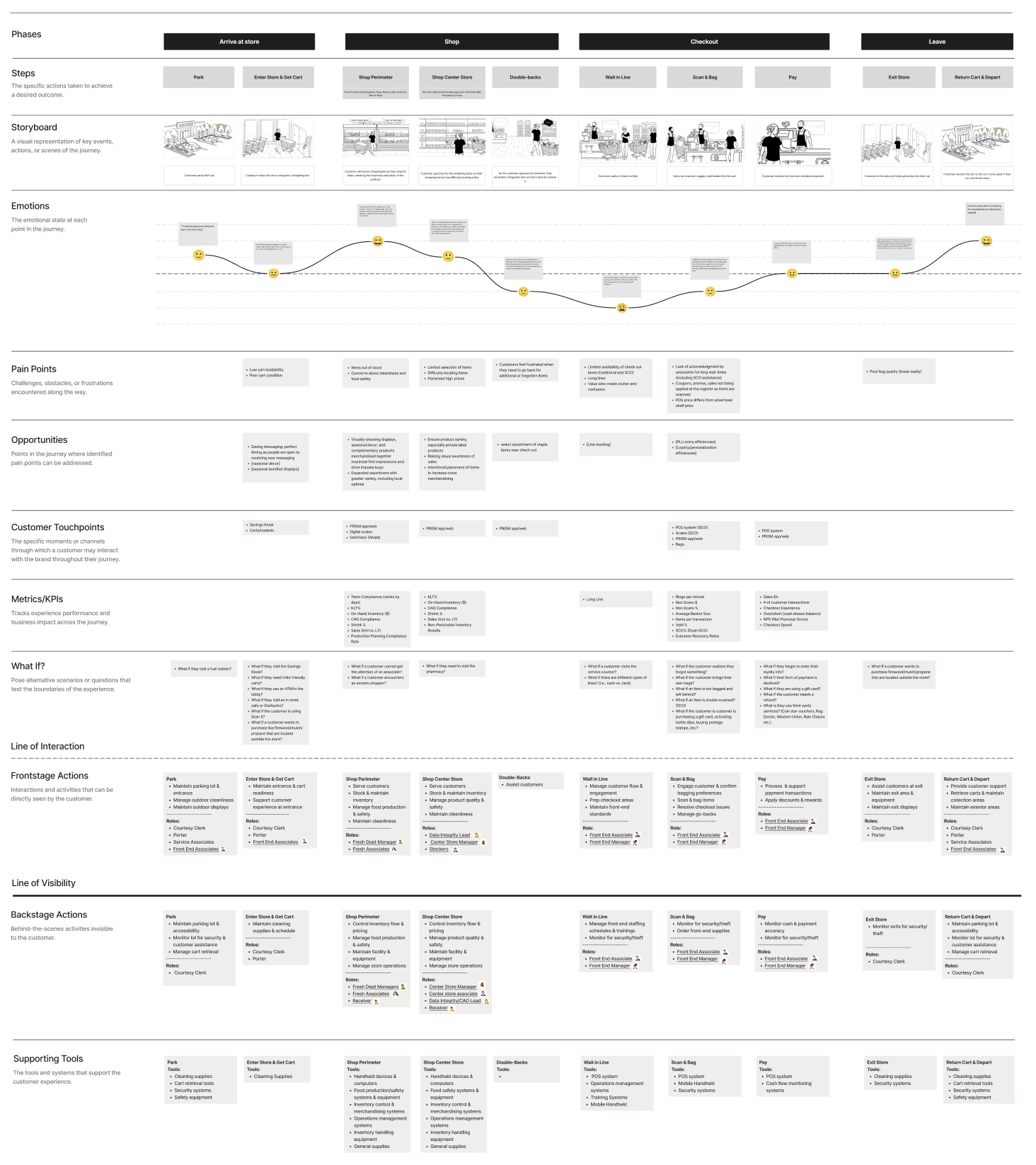
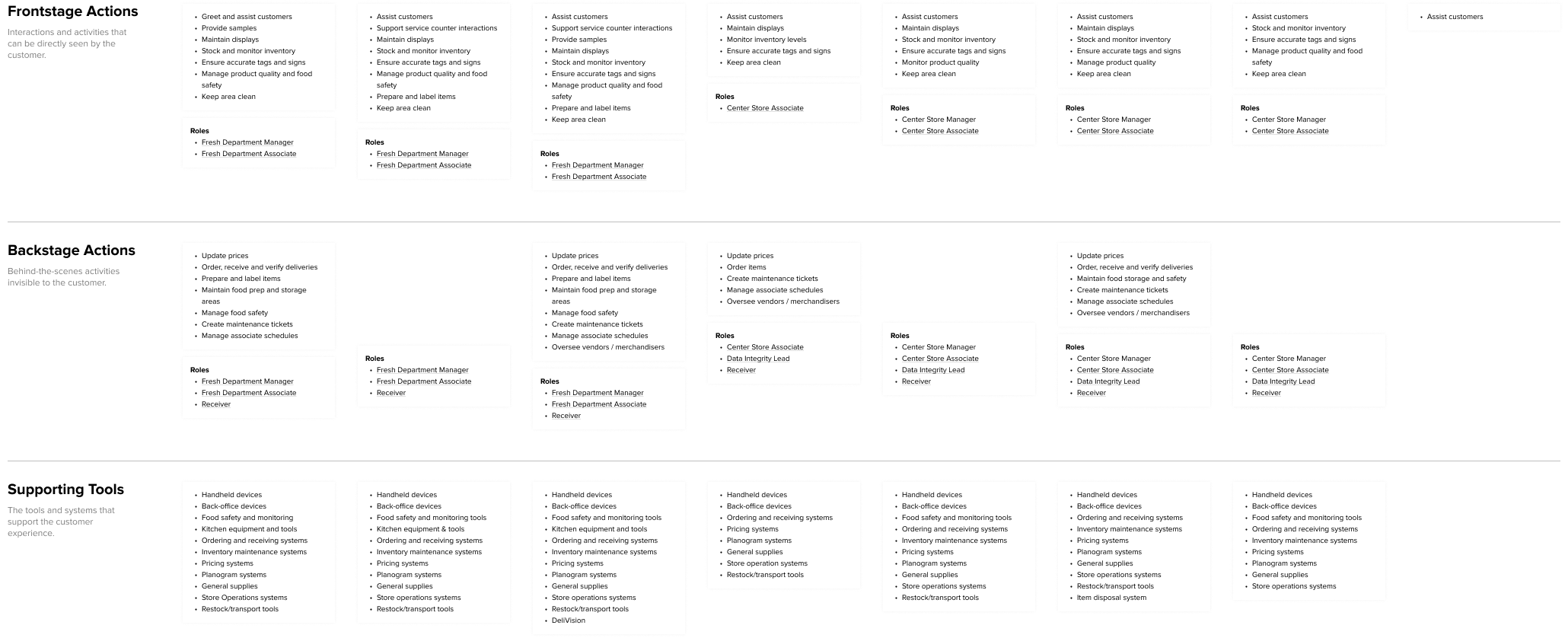
Each journey map incorporates a lightweight service blueprint layer that captures how internal store operations and associates support the customer experience.
This includes
Frontstage associate interactions
Backstage operational activities
Supporting tools and processes
Retail associate personas from the Nexus persona ecosystem were plotted directly onto the maps, allowing users to “double-click” into persona profiles and analyze how specific associate roles contribute to different stages of the journey.
Impact
Connected customer and employee experiences within the same artifact reveal how internal workflows shape the customer experience.
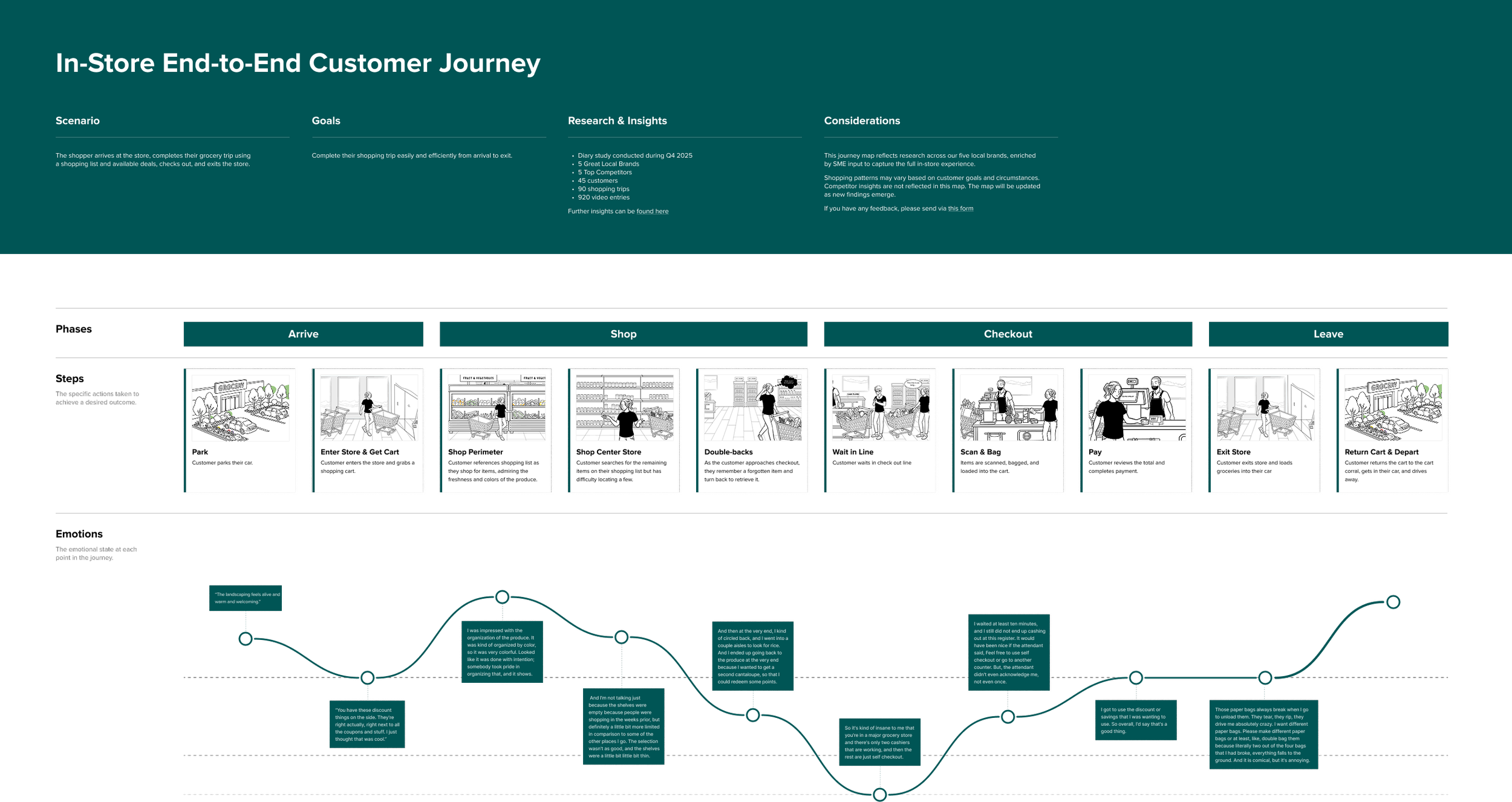
L1 End-to-End Customer Journey Map Storyboard & Emotion Arc
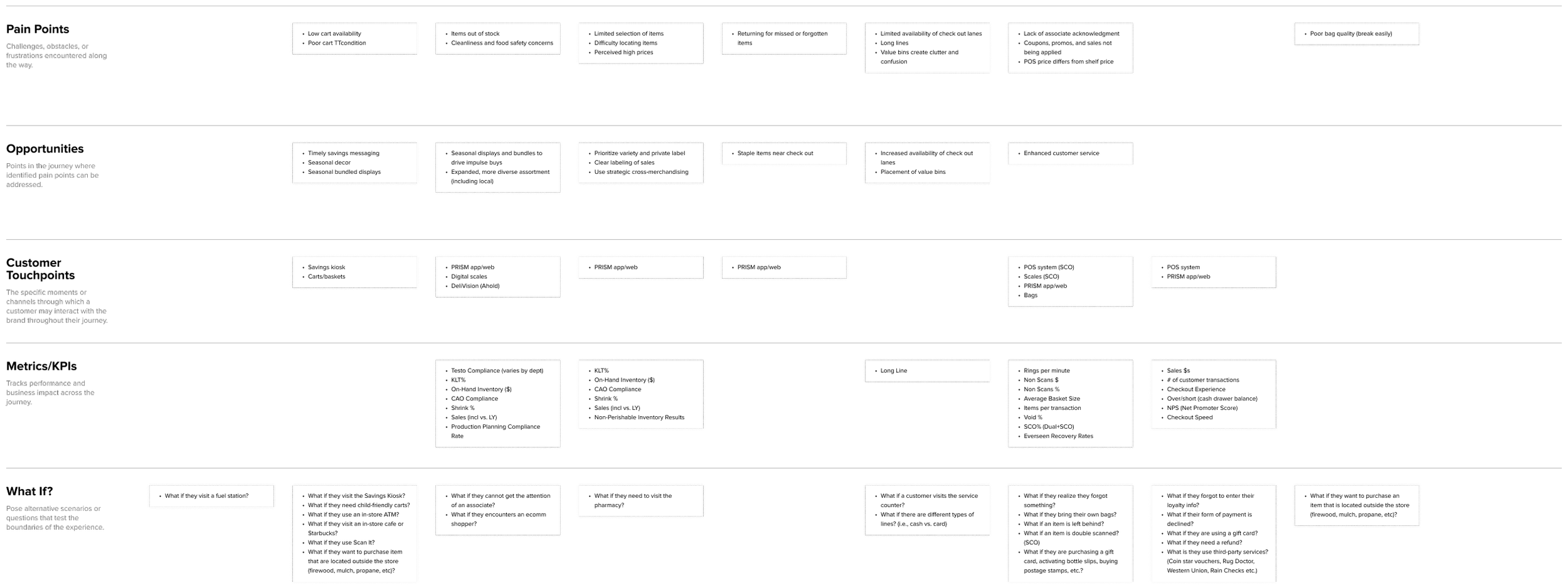
L1 End-to-End Customer Journey Map Pains, Opportunities, Touchpoints, Metrics & What If
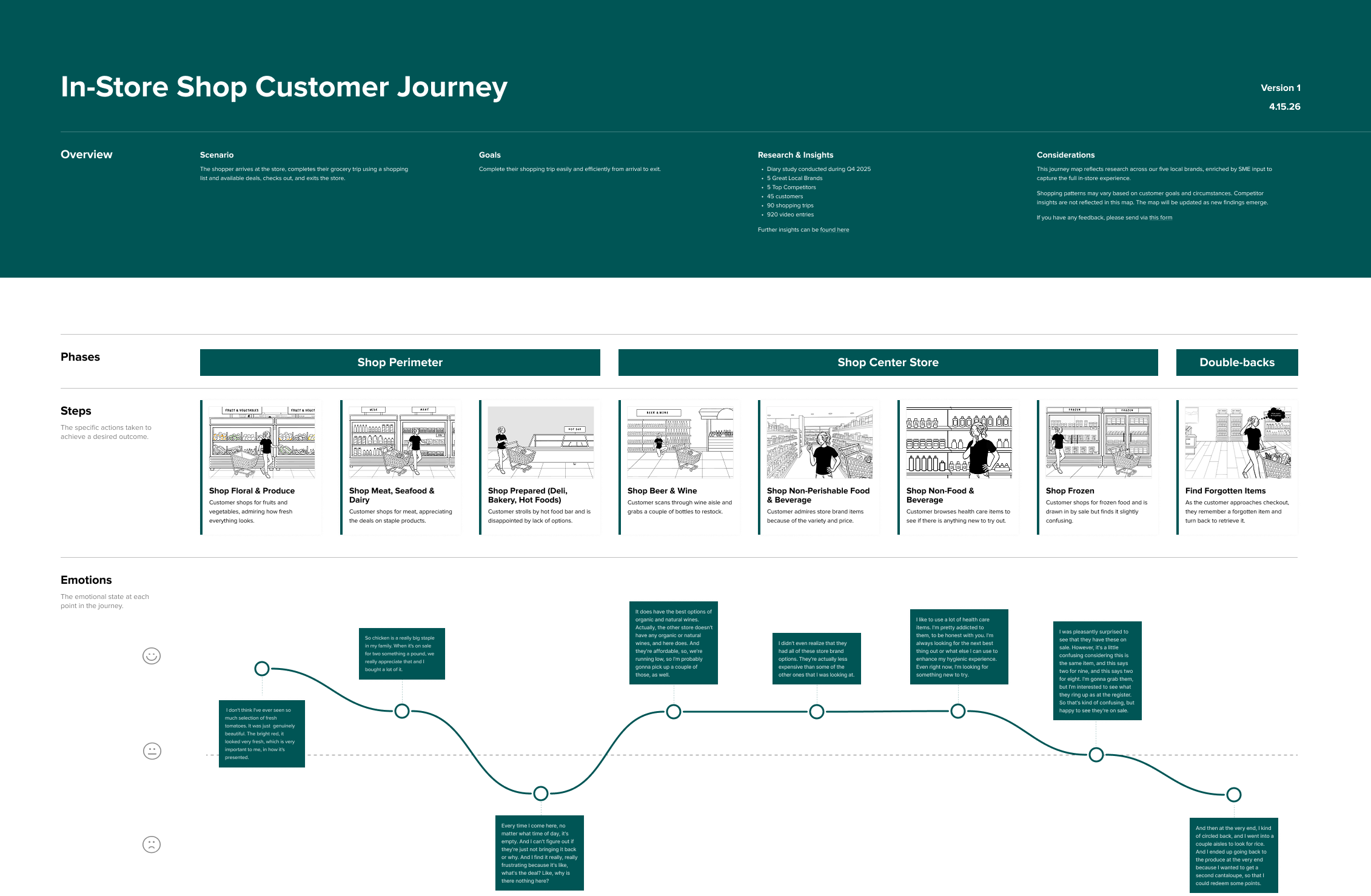
L2 Shop Customer Journey Map Storyboard & Emotion Arc
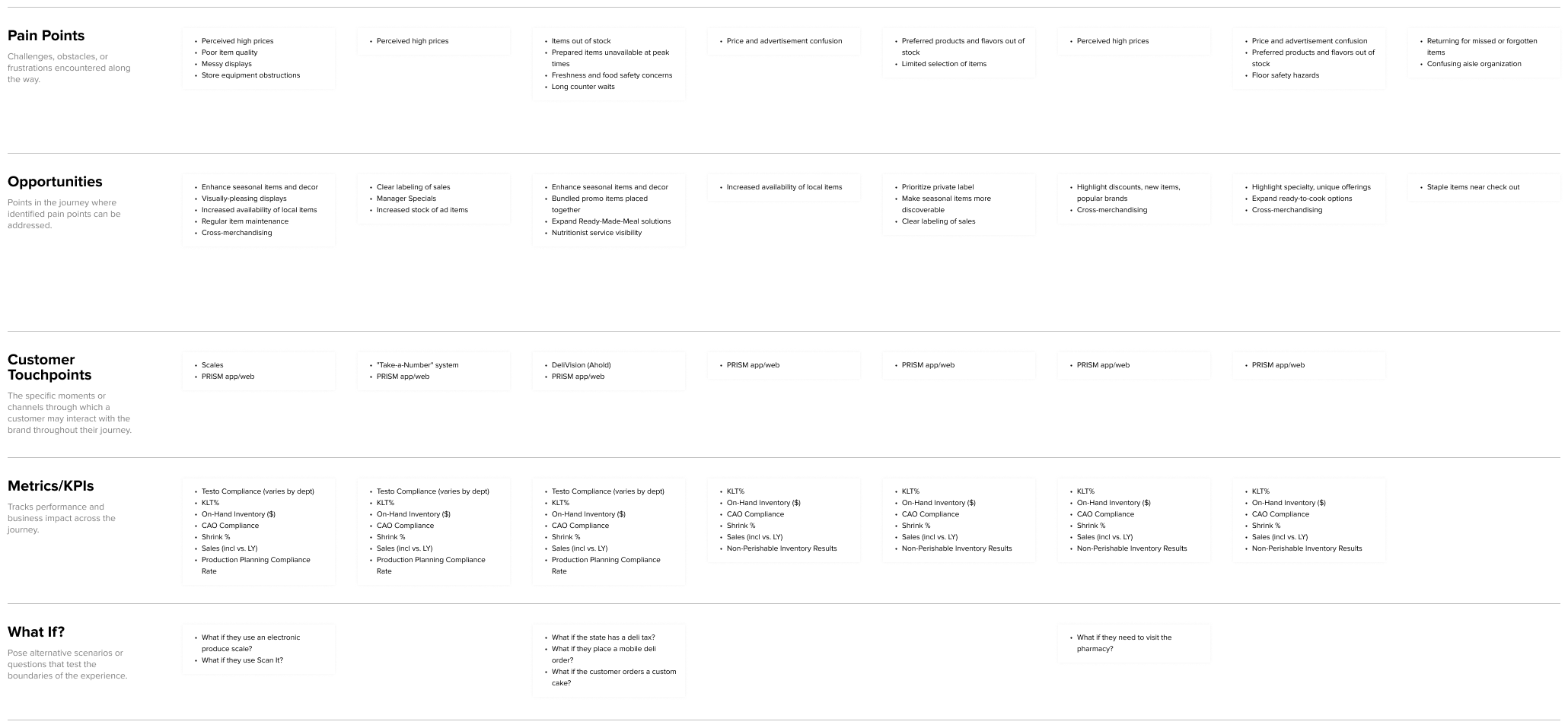
L2 End-to-End Customer Journey Map Pains, Opportunities, Touchpoints, Metrics & What If
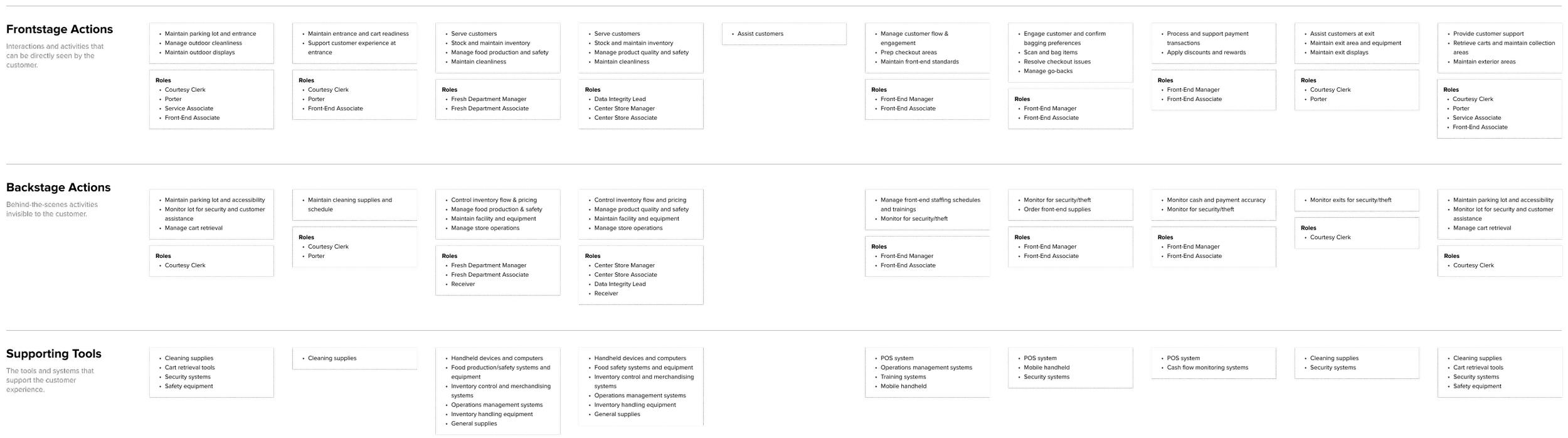
Embedded Service Blueprint Layer
End-to-End and Shop Journey Maps
STRATEGY & FRAMEWORK
Building a journey framework & strategy enabled adaptable, organization-wide journey management at scale.
Working within a fragmented landscape of overlapping initiatives, I reset the approach to accelerate impact holistically vs. focusing on isolated artifacts.
Defined a strategy that connected multiple initiatives and artifacts, including the Nexus Persona Ecosystem, creating an interconnected experience management system.
Defined a foundational journey hierarchy and taxonomy supporting foundational macro (L1) and medium (L2) journeys.
Key Insights
It’s critical to test journey frameworks and taxonomies to ensure they do not break between levels.
Frameworks should be designed to remain flexible rather than overly rigid.
Strategic Decisions & Trade-offs
A reframing towards journey management positioned journey maps as critical governance infrastructure for experience strategy rather than static documentation.
Impact
Created a scalable foundation that positioned journey maps as part of a broader experience management system.

Journey Framework
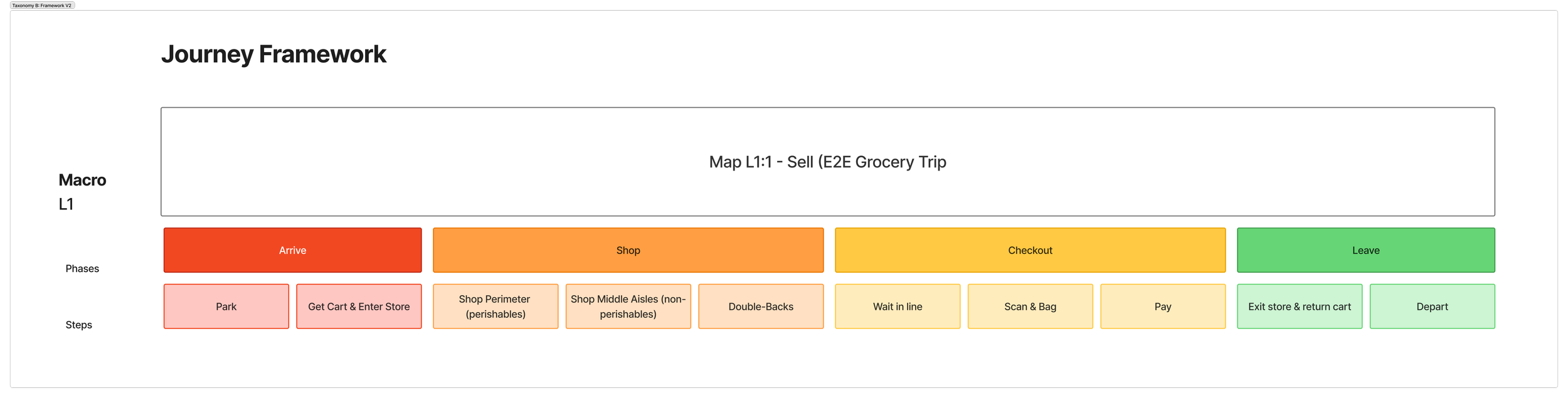
Macro L1 (End-to-End)

Medium L2
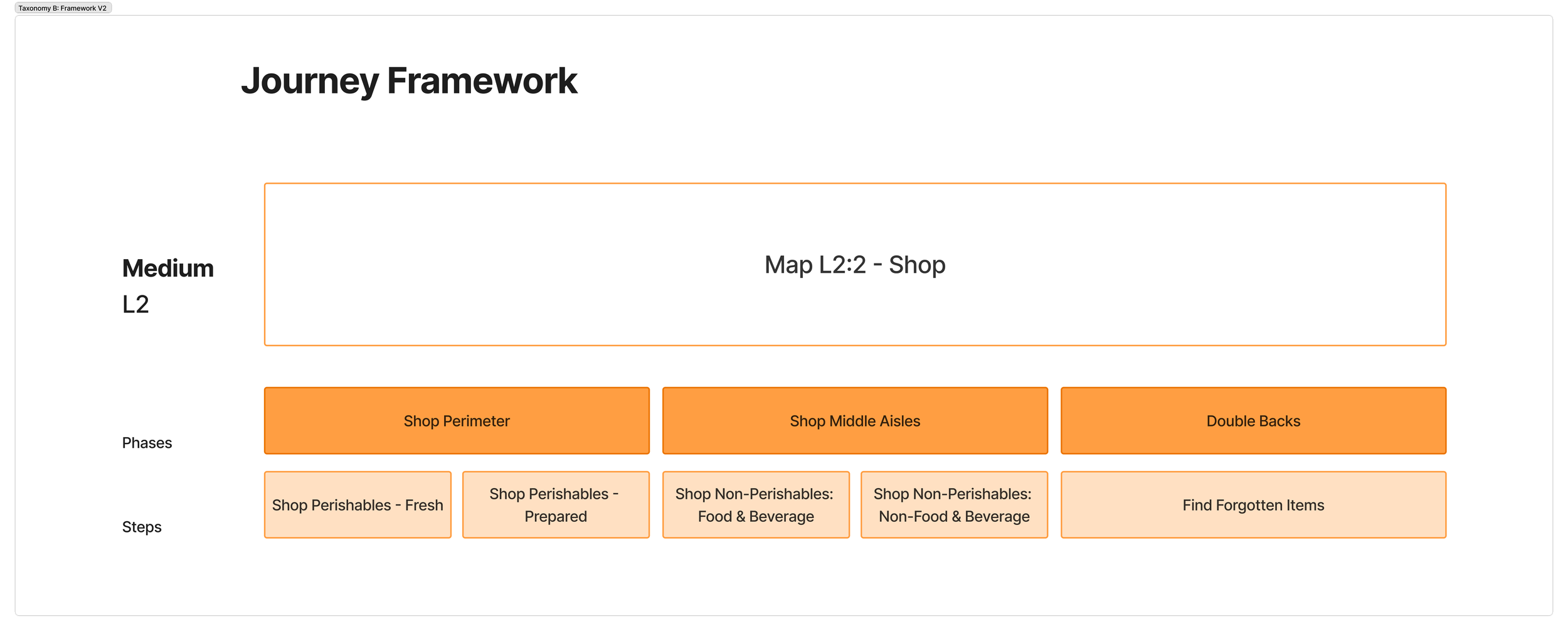
Medium L2: Shop
RESEARCH & INSIGHT SYNTHESIS
Research challenged the narrative, and set the direction.
We conducted a qualitative research effort focused on real customer behavior. We also synthesized existing research and operational knowledge to ensure the framework and maps accurately reflected both customer behaviors and store operations.
Remote, unmoderated diary study spanning all brands and competitors in primary markets.
Synthesized 800+ entries across actions, emotions, and workarounds.
Extant research review of supporting associate workflows, tools, and processes.
Identified key customer goals, behaviors, and pain points.
Analyzed operational insights related to in-store experiences.
Mapped associate roles supporting different stages of the journey.
Key Insights
Navigation and product discovery were frequent sources of friction.
Shopping behaviors differ significantly between browsing and mission-driven trips.
Operational processes often influence customer friction points.
Strategic Decisions & Trade-offs
Customer journeys proved nonlinear and opportunistic, requiring us to abandon a clean, phase-based model as initially expected.
Impact
Ensured journey maps reflected real-world customer and operational dynamics.
JOURNEY MAP DESIGN
Building journey maps to be used as scalable strategic tools, not polished presentations.
Using the journey framework, we developed two connected maps that provided both macro visibility and deeper behavioral insight, while embedding a lightweight service blueprint layer to connect customer and associate experiences.
Created the macro (L1) end-to-end in-store customer experience journey map.
Developed the medium (L2) shop trip journey focused on product selection.
Added a blueprint layer capturing frontstage and backstage activities, and supporting tools and operational processes.
Plotted retail associate personas from the Nexus Persona Ecosystem directly on the maps, enabling linked exploration of associate workflows.
Key Insights
Associate support plays a critical role in the customer journey.
Operational workflows influenced many customer experience outcomes.
Visualizing both customer and associate perspectives revealed stronger, system-level insights.
Strategic Decisions & Trade-offs
Maintained mid-level fidelity to keep maps flexible and evolving.
Chose a lightweight blueprint layer to maintain readability.
Linked personas directly on the maps for easier use in context.
Introduced a “what-if” lane to surface deviations and edge cases.
Added a '“metrics & KPI’s” lane as a mechanism to directly tie the maps back to broader organizational and product strategy.
Added a “Customer touchpoints” lane as a way to bridge the in-person and digital customer experiences to better reflect an omni-channel view.
Impact
The work transformed the journey maps from simple visualizations into living experience system maps, connecting customers, associates, and operations. It revealed systemic opportunities across the in-store experience while creating artifacts that could evolve with new insights and support strategic decision-making.
CO-CREATION & ACTIVATION
Cross-functional collaboration validated content & generated unexpected excitement.
Journey maps were further developed and validated through collaborative workshops with subject matter experts and stakeholders.
Facilitated cross-functional mapping sessions, iterating maps collaboratively with stakeholders and capturing operational insights from store and business partners.
Positioned journeys as evolving artifacts rather than final deliverables.
Currently activating with product teams to identify opportunities for experience improvements and inform strategic roadmaps.
Partnering with UXR to create a complimentary activation deck to further help teams with adoption.
Created a feedback loop for continuous map iteration and improvements.
Key Insights
SME and stakeholder collaboration was especially helpful for the service blueprinting portion of the maps.
Progressive disclosure of the maps helps keep focus and build understanding.
Stakeholders and SME’s immediately recognized the value of journey mapping and expressed excitement about leveraging them as tools across their teams.
Tool and process complexity across 5 different brands was difficult to distill in an easily digestible way on the maps.
Strategic Decisions & Trade-offs
Prioritized working sessions over presentation-driven reviews.
Focused on building shared understanding rather than polished artifacts by working at a very low fidelity in FigJam.
Reframed verbiage in map to be high-level to avoid confusion in an effort to harmonize multi-brand complexity in terms of associate tools and process.
Impact
Built cross-functional alignment and introduced journey thinking as an ongoing practice.
RESULTS & IMPACT
Early impact and validation show promising results.
This work successfully introduced journey mapping practices and created the organization’s first structured view of the end-to-end in-store grocery experience.
Activation & Impact
Established a foundational, scalable journey framework.
Created shared visibility into the full in-store customer experience inclusive of digital touch points (omni-channel).
Connected customer and associate experiences through integrated blueprint layers.
Revealed operational dependencies shaping the experience.
Key Lessons
Building journey maps is challenging! They are most successful when they can condense a large amount of information into a visual that is easy to digest at a glance.
Journey frameworks are essential for scaling mapping practices.
Collaborative mapping builds stronger organizational alignment.
Mid-fidelity artifacts encourage continued iteration and ownership.
Integrating employee workflows provides deeper experience insights.
Next Steps
This work wasn’t about mapping journeys. It was about changing how the organization decides what to build, and what not to. Journey maps will replace the existing ecosystem map in the Nexus Persona Ecosystem, forming Nexus 2.0, a design owned Journey Management system for testing and evolving service design and UX strategy across the org.
Continue the journey by reading these related case studies.
-
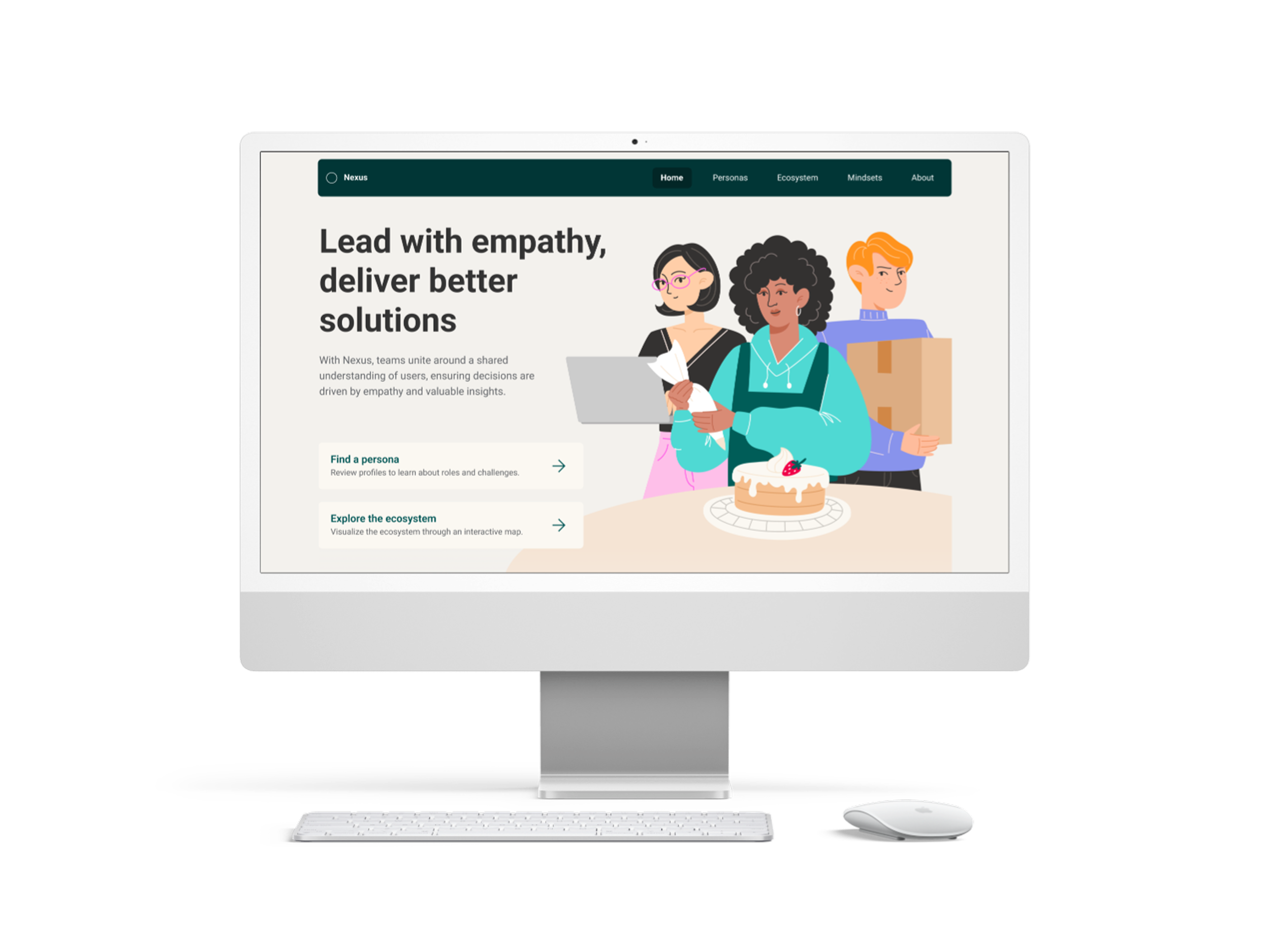
Reveal: Nexus Persona Ecosystem
Turn research into shared understanding.
I built and activated an enterprise ecosystem of 30+ validated personas, supported by AI-enabled research workflows, training, activation tools, and a maturity framework that embeds insight into everyday decision-making.
-
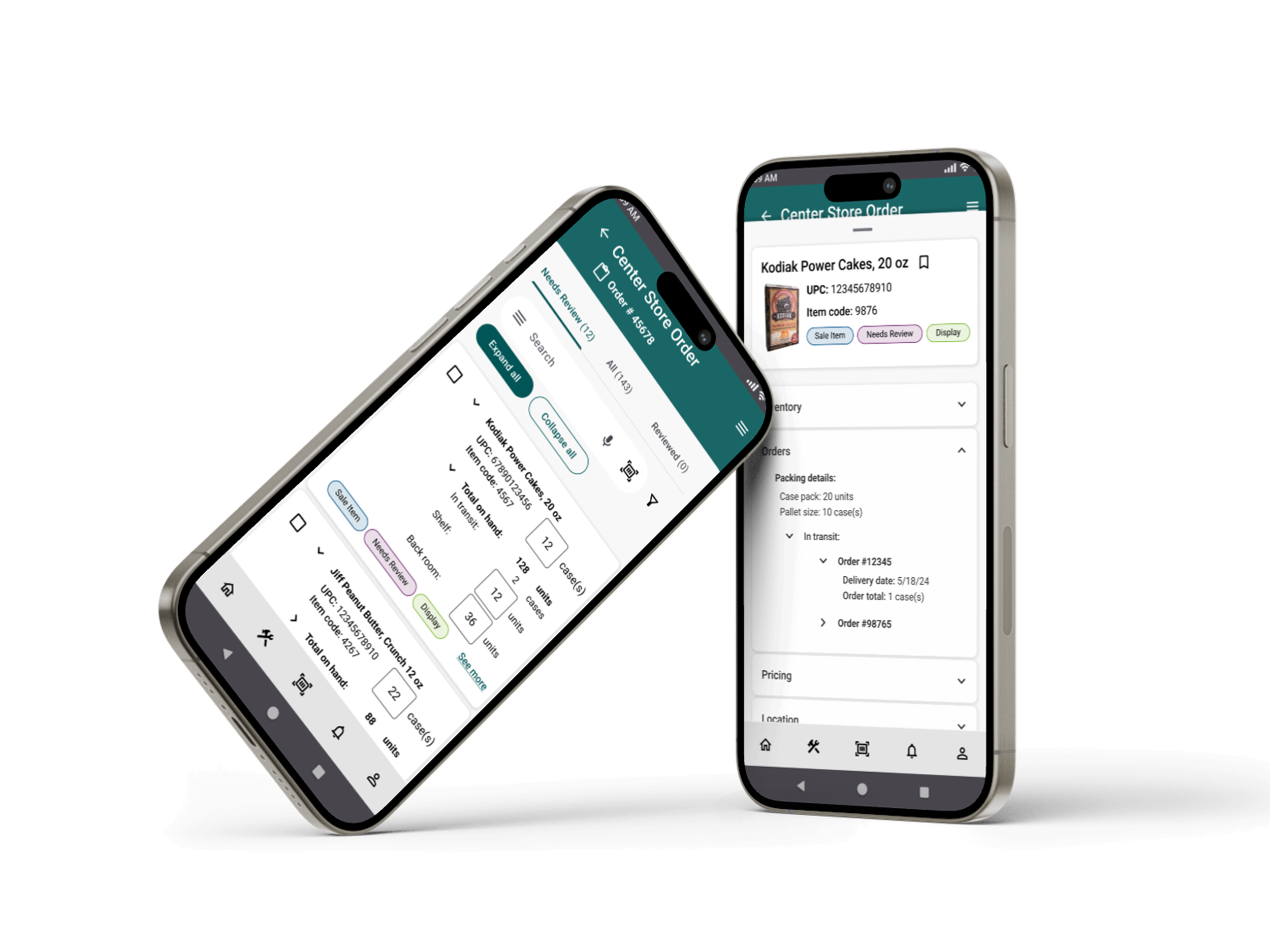
Transform: Legacy System Modernization
Design across people, processes, and technology.
I led a major enterprise modernization initiative consolidating multiple legacy systems and 40+ fragmented workflows into a single future-state concept, aligning leadership on a multi-million-dollar investment strategy.
-
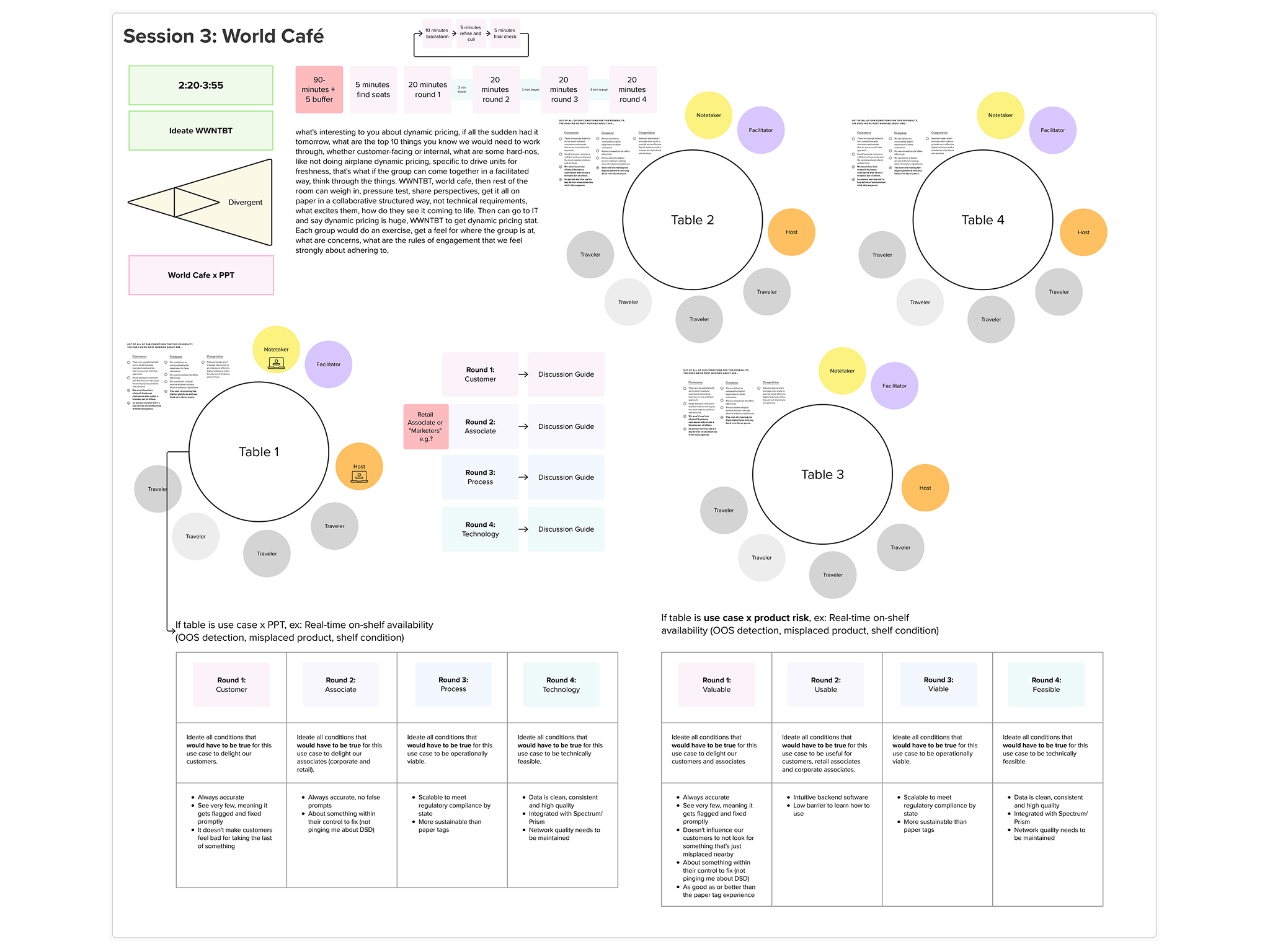
Enable: Executive Visioning & Alignment
Turn complexity into shared direction.
I designed and facilitated a high-stakes executive alignment workshop across brands and business functions, breaking more than a decade of stalled progress to align leaders on a shared Electronic Shelf Label pilot direction.